
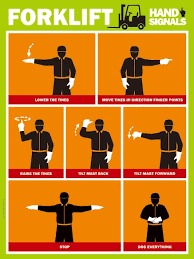
The standard hand signal to stop a forklift is extending one or both arms horizontally to the side at shoulder height, with palms down, and swinging them back and forth. For an emergency stop, cross your arms over your chest and then extend them straight out at shoulder height, or wave both arms rapidly. These clear signals help prevent accidents and keep everyone safe on the warehouse floor.

Why Hand Signals Are Critical for Forklift Safety
Forklifts are powerful machines used daily in warehouses, construction sites, and manufacturing facilities. Because they are loud and the operator’s view can be obstructed by loads, hand signals provide a reliable way for spotters and ground personnel to communicate with the driver. Using standardized signals reduces misunderstandings and helps prevent serious accidents, tip-overs, and collisions. In 2026, OSHA and industry best practices still emphasize clear, visible hand signals as a core part of safe forklift operation.
The Standard Hand Signal to Stop a Forklift
The universal stop signal is simple and highly visible: extend one or both arms horizontally outward at shoulder height with palms facing down, then swing the arms back and forth in a steady motion. This tells the operator to stop immediately and wait for further instructions. The signal is the same whether you are directing a sit-down rider, stand-up forklift, or reach truck. Always make sure the operator can clearly see you before giving any signal, and use large, deliberate movements so there is no confusion.
Emergency Stop Signal
In urgent situations, the emergency stop signal is even more emphatic. Cross both arms over your chest and then quickly extend them straight out at shoulder height with palms down. Alternatively, rapidly wave both arms above your head. This signal demands an immediate full stop — the operator should release the controls and apply the brake right away. Any person on the floor can give an emergency stop signal, and the operator must obey it instantly, even if it comes from someone who is not the designated spotter.
Other Common Forklift Hand Signals
Besides stop signals, operators and spotters use several standard hand signals:
- “Dog Everything” (Pause/Stop All Movement): Clasp hands together in front of the waist. This tells the operator to stop all movement and wait.
- Raise the Load: Raise one arm vertically with palm up and fingers pointing upward, then make a small circular motion.
- Lower the Load: Extend one arm downward with palm facing down and make a small circular motion.
- Move Forward / Backward: Point in the desired direction with one hand while using the other to indicate speed.
All signals should be clear, deliberate, and visible from the operator’s position.
Common Mistakes to Avoid
Even experienced spotters sometimes make mistakes that can lead to confusion or accidents:
- Using vertical arm movements when signaling stop (this can be confused with raise/lower signals)
- Giving signals from a position the operator cannot clearly see
- Using unclear or half-hearted gestures
- Not establishing who the designated spotter is before starting the operation
To avoid these issues, always confirm the operator can see you and use large, consistent movements.
Safety Best Practices When Using Hand Signals
For maximum safety, follow these guidelines:
- Only one designated spotter should give signals during normal operations.
- The operator must acknowledge each signal before proceeding.
- In busy or noisy environments, combine hand signals with verbal communication or radios when possible.
- Ensure the spotter wears high-visibility clothing and stands in a safe location.
- Never allow anyone to stand under a raised load, even while signaling.
Regular training and refresher courses keep everyone on the same page and reduce the risk of miscommunication.
Conclusion
The hand signal to stop a forklift is clear and standardized for a reason: it saves lives and prevents costly accidents. Extending your arm(s) horizontally at shoulder height with palms down and swinging them back and forth is the universal “stop” command. For emergencies, use the crossed-arm or rapid-wave signal. By learning and consistently using these signals, along with proper training and clear communication, you can help create a much safer workplace for everyone around forklifts.
 English
  French
  Spanish
  Vietnamese
  Thai
Thai  Italian
  Arabic
  Malay
Malay  Portuguese
  German
  Russian
  Japanese
  Korean
  Lao
Lao  Indonesian
  Turkish
  Irish
Irish  Uzbek
Uzbek