
The forklift was invented in the early 20th century, with its roots in the late 1910s and early 1920s. While early non-lifting battery trucks appeared around 1906, the first true powered industrial lifting forklift is credited to Clark Equipment Company, which developed the Tructractor in 1917 and advanced models by 1922–1924.
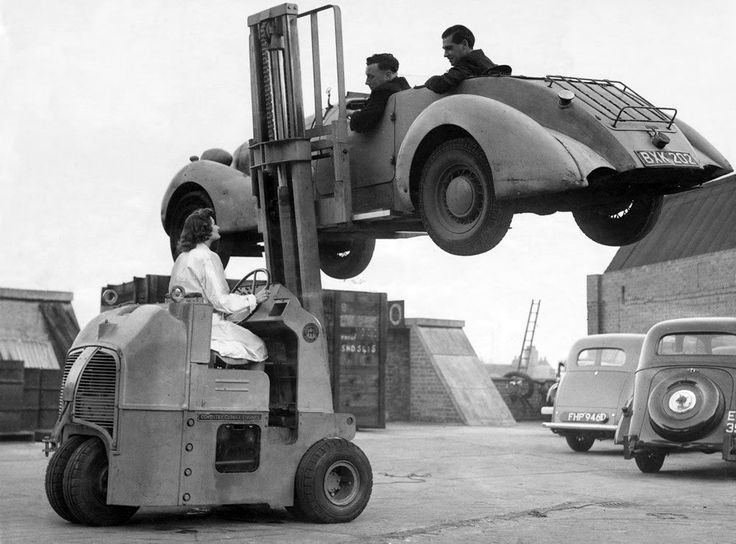
The Birth of the Modern Forklift
The story of the forklift begins not with a single dramatic invention but with a series of practical innovations driven by the needs of rapidly growing factories and warehouses in the early 1900s. Before the forklift, moving heavy materials was labor-intensive and dangerous. Workers relied on manual labor, ropes, pulleys, and basic carts. The demand for faster, safer, and more efficient material handling led engineers to experiment with powered industrial trucks. These early experiments laid the foundation for what would eventually become the forklift we recognize today.
Early Developments: 1906–1917
The first important milestone came around 1906 when several companies began building battery-powered platform trucks. These vehicles could move materials horizontally but had no lifting capability. They were essentially motorized versions of hand-pulled carts. The real breakthrough occurred in 1917 when the Clark Equipment Company introduced the “Tructractor.” Originally designed as a tractor for pulling wagons in factories, this machine featured a gasoline engine and became widely used for moving heavy loads. Although it did not lift, the Tructractor is widely considered the direct ancestor of the modern forklift because it proved the concept of a compact, powered industrial vehicle.
The First True Lifting Forklifts: 1920s
Between 1920 and 1923, several manufacturers began adding vertical lifting mechanisms to their industrial trucks. Yale & Towne Manufacturing and other companies experimented with forks and masts that could raise loads off the ground. The pivotal moment came in 1922–1924 when Clark introduced its first true fork-equipped lifting truck. This model combined the mobility of the earlier Tructractor with a hydraulic or mechanical lifting mast. These early lifting trucks were still crude by today’s standards, but they marked the birth of the forklift as a specialized material-handling machine. By the late 1920s, the basic design principles — forks, mast, and counterweight — were firmly established.
The 1930s: Pallets and Standardization
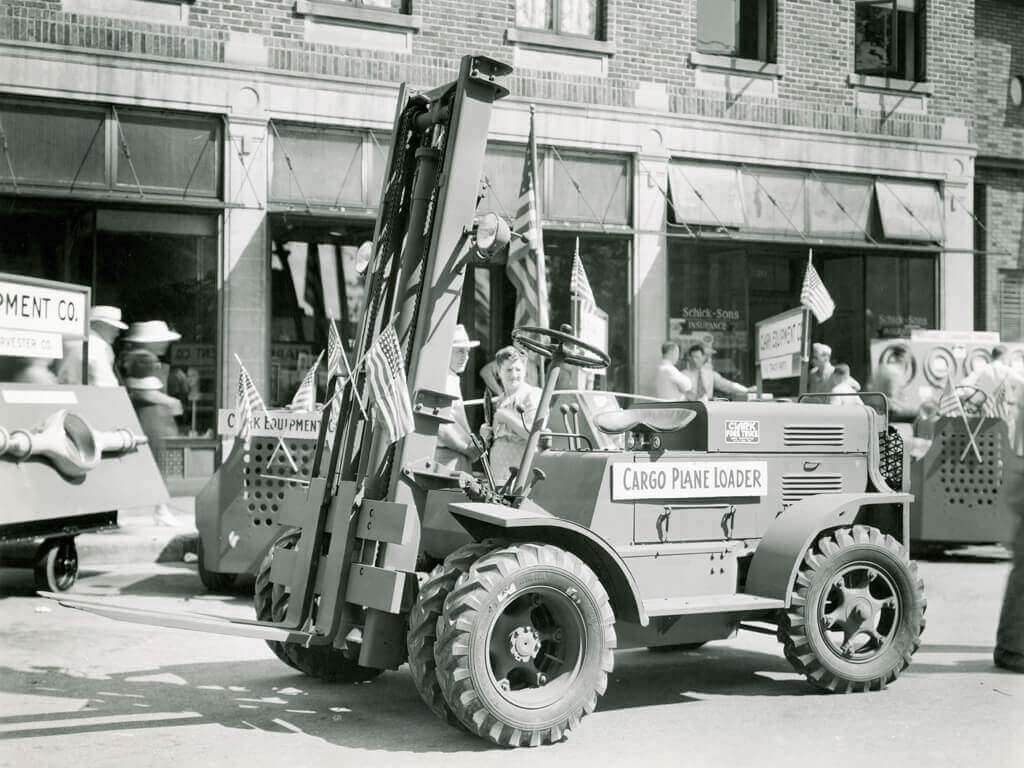
The 1930s brought another major leap forward. The standardization of wooden pallets allowed forklifts to handle loads far more efficiently. Clark introduced the “Carloader” in 1938, one of the first compact internal-combustion forklifts designed specifically for warehouse use. This model featured better maneuverability and lifting capacity, setting the stage for widespread adoption after World War II. The war itself accelerated forklift development, as military supply depots needed fast, reliable ways to move large quantities of materials.
What Was Used Before Forklifts?
Before the invention of the forklift, warehouses and factories relied on extremely labor-intensive methods. Workers used hand trucks, dollies, wheelbarrows, and simple platform carts pulled by horses or people. Heavy loads were moved using ropes, pulleys, block and tackle systems, or inclined ramps. In larger facilities, overhead cranes and hoists handled vertical movement, but horizontal transport remained slow and dangerous. These methods required large teams of workers, resulted in frequent injuries, and severely limited productivity. The forklift revolutionized material handling by combining horizontal movement and vertical lifting into a single, compact machine operated by one person.
What Is the Lifespan of a Forklift?
A well-maintained forklift typically lasts 10 to 15 years or 10,000 to 20,000 operating hours, depending on usage intensity and maintenance quality. Electric forklifts often outlast internal-combustion models because they have fewer moving parts and less vibration. Heavy daily use in harsh environments can shorten lifespan to 7–10 years, while light-duty warehouse service can extend it beyond 15 years. Regular maintenance, timely replacement of wear parts (tires, brakes, hydraulic seals), and proper battery care (for electric models) are the biggest factors in maximizing service life. Many companies rebuild or refurbish forklifts after 8–10 years, effectively giving them a second life at a fraction of the cost of a new unit.
Modern Forklift Development
Since the 1950s, forklift technology has continued to evolve. The introduction of electric models in the 1960s and 1970s brought quieter, emission-free operation suitable for indoor use. The 1980s and 1990s saw improvements in ergonomics, safety features, and electronic controls. Today’s forklifts feature advanced safety systems, lithium battery options, and sophisticated telematics that track usage and maintenance needs. Despite these advancements, the fundamental design principles established in the 1920s — forks, mast, and counterweight — remain the foundation of modern forklift engineering.
Conclusion
The forklift was invented in the early 20th century, with the first practical lifting models appearing between 1917 and 1924. Clark Equipment Company played a pivotal role with the Tructractor and subsequent lifting trucks. Before forklifts, material handling was slow, dangerous, and labor-intensive. Today’s machines are far more advanced, but they still trace their roots to those pioneering designs of the 1920s. Understanding this history helps appreciate how far forklift technology has come and why proper maintenance remains essential for long service life.
 English
  French
  Spanish
  Vietnamese
  Thai
Thai  Italian
  Arabic
  Malay
Malay  Portuguese
  German
  Russian
  Japanese
  Korean
  Lao
Lao  Indonesian
  Turkish
  Irish
Irish  Uzbek
Uzbek