
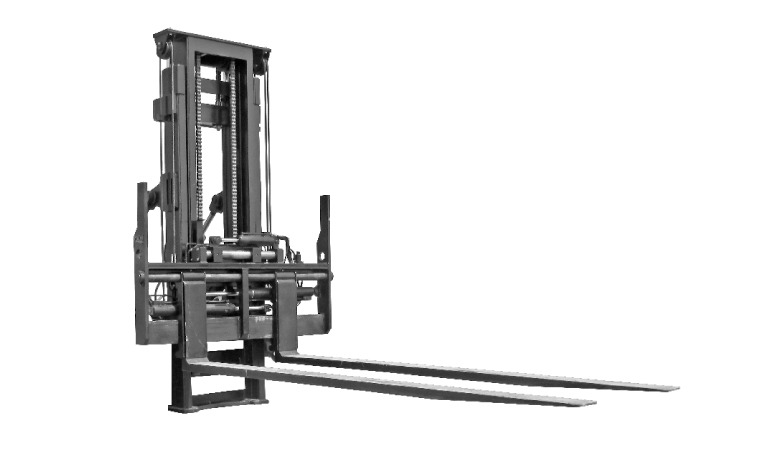
The mast on a forklift is the vertical assembly at the front that lifts, lowers, and tilts loads. Comprised of nested, hydraulically powered steel channels and chains, it controls the carriage and forks to move materials vertically. Masts are crucial for reaching various heights, with common types being single-stage, 2-stage, 3-stage (triplex), and 4-stage.
What Is the Purpose of a Mast?
The forklift mast serves as the primary lifting mechanism, enabling the machine to raise, lower, and position heavy loads safely and precisely. Its main purpose is to provide vertical movement while maintaining stability. Without a well-designed mast, a forklift would be limited to ground-level transport only. The mast allows operators to stack pallets in high racking, load and unload trucks at different heights, and reach into deep storage locations. It works in coordination with the carriage and forks to ensure loads remain secure during lifting and travel. Proper mast function is essential for both productivity and safety in warehouses, manufacturing plants, and distribution centers.
What Are the Components of a Forklift Mast?
A forklift mast is a complex assembly made up of several key components working together:
- Outer Rails (Fixed Mast): The outermost steel channels that form the structural backbone and remain stationary relative to the forklift frame.
- Inner Rails (Moving Sections): Nested inside the outer rails, these sections telescope upward when lifting. Most masts have two or three inner stages for greater reach.
- Hydraulic Lift Cylinders: Powerful cylinders that extend to push the inner rails upward. They are the main source of lifting force.
- Roller Chains and Pulleys: Heavy-duty chains connected to the carriage. As the cylinders extend, the chains pull the carriage and forks upward with mechanical advantage.
- Carriage: The moving platform that holds the forks and allows them to slide side-to-side (side shift) on some models.
- Tilt Cylinders: Smaller cylinders at the base that control forward and backward tilt of the entire mast assembly.
These components work together seamlessly. When the operator activates the lift control, hydraulic fluid is pumped into the cylinders, causing them to extend and raise the inner rails. The chains then lift the carriage and forks to the desired height. The tilt cylinders allow the operator to angle the mast slightly back to cradle the load securely during travel.
Types of Forklift Masts
Forklift masts come in several configurations, each designed for different height and application needs:
- Single-Stage Mast: The simplest design with only one moving section. Limited to lower lift heights but offers excellent visibility and strength.
- Two-Stage Mast: Provides moderate lift heights with good visibility. Common on standard warehouse forklifts.
- Three-Stage (Triplex) Mast: The most popular type for general use. Offers high reach (up to 20+ feet) while maintaining reasonable collapsed height for doorway clearance.
- Four-Stage Mast: Used for very high stacking in specialized applications. Provides maximum reach but reduces visibility and increases overall machine height when lowered.
The choice of mast type depends on warehouse ceiling height, racking levels, and specific operational requirements. Higher-stage masts allow greater vertical reach but may reduce forward visibility and require more careful operation.
How the Mast Works in Practice
When the operator pulls the lift lever, hydraulic fluid is forced into the lift cylinders. The pressure extends the cylinders, pushing the inner mast sections upward. Simultaneously, the roller chains connected to the carriage multiply this motion, raising the forks smoothly and controllably. The tilt function works independently through separate cylinders that pivot the entire mast assembly forward or backward. This combination of lift and tilt gives the operator precise control over load positioning, whether picking up a pallet from the floor or placing it on a high shelf.
Maintenance and Safety Considerations
Regular mast maintenance is essential for safe operation. Operators should inspect chains for wear, check hydraulic hoses for leaks, and ensure rollers move freely without binding. Lubrication of chains and rollers according to manufacturer specifications prevents premature failure. Safety features such as load backrests, chain tensioners, and tilt lock valves protect both the operator and the load. Any unusual noise, binding, or drift in the mast should be reported immediately for professional inspection.
Conclusion
The forklift mast is the heart of vertical material handling. Its nested rails, hydraulic cylinders, chains, and carriage work together to lift and position loads with precision and safety. From simple single-stage designs to advanced four-stage masts, this critical component enables warehouses and factories to maximize storage space and operational efficiency. Understanding how the mast works helps operators use the equipment safely and maintain it properly for long service life.
 English
  French
  Spanish
  Vietnamese
  Thai
Thai  Italian
  Arabic
  Malay
Malay  Portuguese
  German
  Russian
  Japanese
  Korean
  Lao
Lao  Indonesian
  Turkish
  Irish
Irish  Uzbek
Uzbek