
Moving a dead electric forklift is best achieved by towing it with a larger forklift, using a temporary power source (like daisy-chained 12V car batteries) to release the brake, or removing the battery to free up wheels, typically needing to move it at speeds below 2 km/h. The safest methods prioritize towing on level surfaces and using a second, functioning forklift to move it to a charging station.
Why Moving a Dead Electric Forklift Requires Special Care
A “dead” electric forklift — one with a completely discharged or faulty battery — cannot power its drive motor or release the electromagnetic parking brake. This creates a heavy, immovable object that poses risks if moved incorrectly. Attempting to push or tow it without proper technique can damage the transmission, brake system, or frame. In warehouses and distribution centers, quick, safe relocation to a charging station or repair area is essential to minimize downtime. The methods below follow manufacturer guidelines and OSHA best practices for handling disabled material-handling equipment.
Method 1: Towing with Another Forklift (Most Common & Safest)
The preferred method for most facilities is towing with a larger, fully operational forklift. Use a heavy-duty tow bar or chain rated for at least twice the weight of the dead unit. Attach the tow point to the rear frame or designated towing eye (never to the mast or forks). Keep the towed forklift in neutral, ensure the parking brake is released (if possible), and maintain a slow, steady speed under 2 km/h (1.2 mph). A spotter should walk alongside to monitor clearance and stability. This method works on level concrete floors and avoids stressing the disabled forklift’s drivetrain.
Method 2: Temporary Power / Jump Start to Release the Brake
Many electric forklifts use an electromagnetic brake that locks when power is lost. To release it safely:
- Connect a temporary 24V or 36V power source (commonly two or three 12V car batteries in series) to the main battery connector or auxiliary power port.
- Turn the key to ON — the brake should release with an audible click.
- Once moving, maintain the temporary power or quickly reconnect the main battery.
Never attempt this without proper cables and voltage matching. Incorrect voltage can damage the controller or motor. This method is ideal when the forklift is close to a charging station.
Method 3: Manually Releasing the Parking Brake
Some Yale, Toyota, and Crown models have a manual brake release lever or bolt. Consult the specific operator manual for your model. Typically, you remove a protective cover, insert a release tool or wrench, and turn it to disengage the brake. Once released, the wheels roll freely. This method requires two people and should only be done on flat ground with wheel chocks in place to prevent rolling. Re-engage the brake immediately after moving the forklift.
Method 4: Removing the Battery to Free the Wheels
On many electric forklifts, removing the heavy battery pack reduces overall weight and allows the unit to be pushed or towed more easily. Use a proper battery hoist or crane rated for the pack’s weight (often 800–4,000 lbs). After removal, the forklift becomes significantly lighter and the brake may release manually. This is a last-resort method and requires trained personnel and proper equipment. Always reinstall the battery before attempting to operate the forklift again.
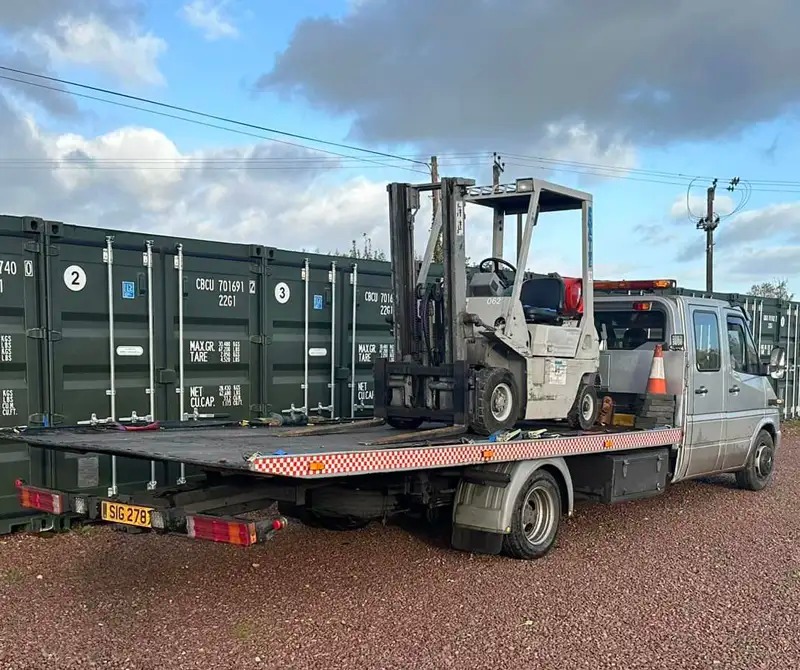
How to Transport an Electric Forklift?
For longer distances or loading onto a trailer:
- Use a flatbed truck or lowboy trailer with proper tie-down points.
- Secure the forklift at the frame (never the mast or forks).
- Chock all wheels and use heavy-duty straps or chains.
- Disconnect the battery and secure it separately to prevent shifting.
- Transport at low speed and avoid sharp turns.
Professional forklift transport companies or rental dealers often provide this service with specialized equipment and insurance coverage.
Safety Tips and Best Practices
Always wear PPE, use wheel chocks, and never stand in the path of a moving forklift. Document the move and notify maintenance immediately. If the forklift has been dead for an extended period, the battery may need a slow charge before reuse. Never attempt to move a dead forklift alone or with improvised equipment.
Conclusion
Moving a dead electric forklift requires careful planning and the right method for your situation. Towing with another forklift is usually the safest and fastest option, while temporary power or manual brake release works well for short distances. Battery removal is a last resort. Proper technique prevents damage, reduces downtime, and keeps everyone safe.
 English
  French
  Spanish
  Vietnamese
  Thai
Thai  Italian
  Arabic
  Malay
Malay  Portuguese
  German
  Russian
  Japanese
  Korean
  Lao
Lao  Indonesian
  Turkish
  Irish
Irish  Uzbek
Uzbek