
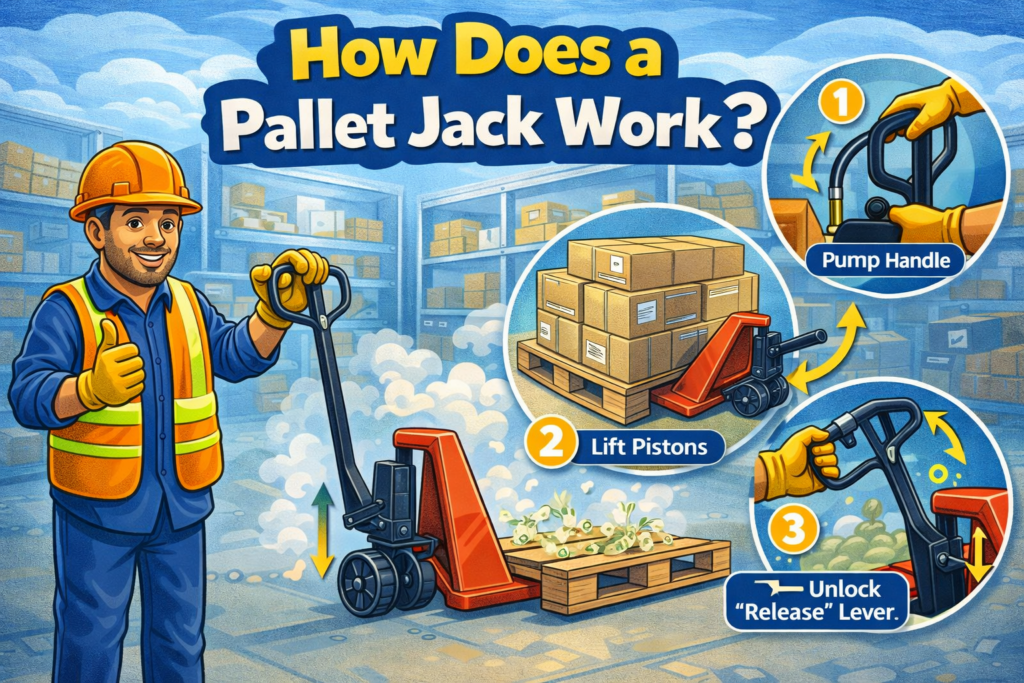
A pallet jack works by using a hand-pumped or electric hydraulic mechanism to lift heavy loads, utilizing a piston and hydraulic oil to raise the forks a few inches off the ground. The operator steers with a handle (tiller) to transport pallets, using a lever to release the pressure, lowering the load.
Understanding the Basic Principle
A pallet jack, also known as a pallet truck or pump truck, is one of the most essential tools in warehouses, retail stores, and distribution centers. It uses simple yet effective hydraulic principles to lift and move heavy palletized loads over short distances. The core mechanism relies on Pascal’s Law — pressure applied to a confined fluid is transmitted equally in all directions. When the operator pumps the handle, hydraulic oil is forced into a cylinder, raising the forks. Releasing the pressure allows the load to lower smoothly under gravity. This design makes pallet jacks highly efficient, affordable, and easy to operate even for a single person.
How It Works Step-by-Step
1. Positioning
The first step is to align the pallet jack correctly. Approach the pallet straight on and fully insert the forks under the pallet. The forks must go as far as possible for maximum stability. Never attempt to lift a pallet with the forks only partially inserted — this creates dangerous leverage and can cause the load to tip or damage the jack.
2. Lifting
Once the forks are fully under the pallet, move the control lever to the “lift” or “neutral” position. Pump the handle up and down several times. Each pump forces hydraulic oil into the main cylinder, raising the forks and the entire pallet a few inches off the ground. Most standard pallet jacks lift between 3 to 8 inches — just enough to clear the floor for safe movement.
3. Moving
With the load raised, use the long handle (tiller) to steer and move the pallet jack. Most operators pull the load rather than push it because pulling offers better visibility and control. Move at a steady walking pace. Avoid sudden stops or sharp turns, especially when carrying heavy or tall loads. Electric pallet jacks make this step effortless with a powered drive motor.
4. Lowering
When you reach the destination, position the pallet exactly where it needs to go. Squeeze or push the release lever to open the hydraulic valve. This allows the pressurized oil to flow back into the reservoir, gently lowering the forks and pallet to the ground. Withdraw the forks straight out once the load is fully lowered.
Manual vs Electric Pallet Jacks
Manual pallet jacks rely entirely on operator power to pump the handle. They are lightweight, inexpensive, and perfect for light to medium-duty tasks. Electric pallet jacks use a battery-powered motor for both lifting and driving, greatly reducing physical effort. Models like the pallet jack from Liftron offer stand-up or walkie operation with smooth electric assistance, making them ideal for high-volume warehouses.
What Are the Common Problems with Pallet Jacks?
Common issues include hydraulic leaks, stuck wheels, bent forks, and failing pumps. Regular inspection of seals, wheels, and the hydraulic system prevents most problems. Always store pallet jacks with forks lowered and in a designated area to avoid accidents and extend equipment life.
Conclusion
A pallet jack is a simple yet powerful tool that relies on basic hydraulic principles to lift and move heavy loads efficiently. By understanding the correct positioning, lifting, moving, and lowering sequence, operators can work safely and productively. Whether you choose a basic manual model or a modern electric version, proper technique and regular maintenance ensure years of reliable service. For professional-grade pallet jacks built for durability and ease of use, explore high-quality options from trusted material handling specialists.
 English
  French
  Spanish
  Vietnamese
  Thai
Thai  Italian
  Arabic
  Malay
Malay  Portuguese
  German
  Russian
  Japanese
  Korean
  Lao
Lao  Indonesian
  Turkish
  Irish
Irish  Uzbek
Uzbek