
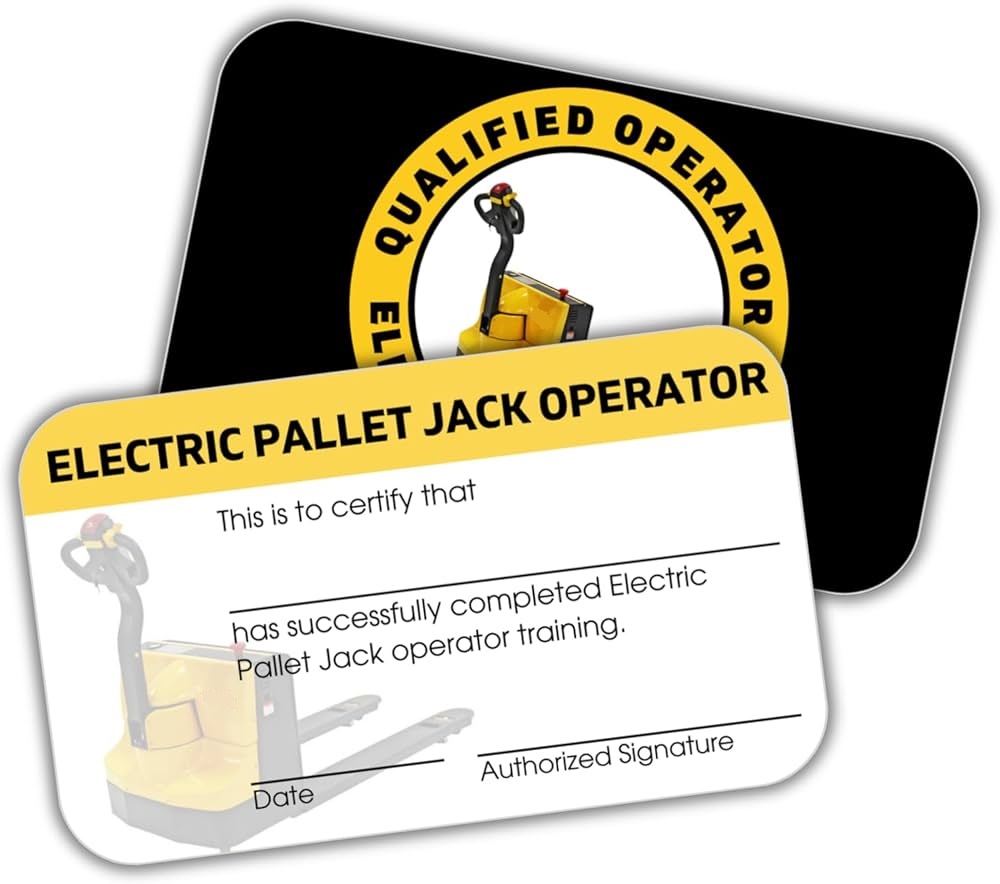
Getting a pallet jack certification is required for motorized models and highly recommended for manual ones. The process involves completing short formal training—often available online in just 1-2 hours—followed by a hands-on, employer-led performance evaluation. OSHA mandates this certification to ensure safe operation, and upon successful completion you receive an official certificate and wallet card.
Why Pallet Jack Certification Is Required
OSHA classifies powered pallet jacks as Class III powered industrial trucks under 29 CFR 1910.178. Employers must train and certify every operator before allowing independent use. Proper certification dramatically reduces accidents, injuries, and costly damage while protecting your company from OSHA fines. Even for manual pallet jack models, structured training is considered best practice by safety professionals and many warehouse employers.
Who Needs Certification?
Powered (electric) pallet jack operators must be formally trained, evaluated, and certified. Operators must be at least 18 years old. Manual pallet jacks are not classified as powered equipment, so federal OSHA certification is not legally required. However, most forward-thinking companies still require or strongly recommend full training for manual models to prevent strains, tip-overs, and collisions.
Steps to Get Pallet Jack Certification
1. Register for Training
Choose an OSHA-compliant training provider. Hundreds of reputable online courses are available 24/7. Simply visit the provider’s website, create a free account, select the pallet jack course, and purchase (typical cost $35–$95). No previous experience is necessary. Many courses are mobile-friendly and can be started instantly.
2. Complete the Formal Training (Theory)
This section covers all essential knowledge:
- Types of pallet jacks (manual vs. electric walkie/rider)
- Controls, features, and daily inspections
- Load capacity, stability triangle, and center of gravity
- Safe loading, unloading, and traveling techniques
- Hazard recognition (ramps, pedestrians, narrow aisles, uneven floors)
- Battery charging and maintenance for electric models
- OSHA rules and your employer’s specific policies
Most online modules take 60–120 minutes and include videos, illustrations, and short quizzes.
3. Pass the Written Exam
After completing the lessons, take the final theory exam. The standard passing score for pallet jack certification is 70% or higher on the written test. Some providers require 80%. You can usually retake the exam at no extra cost until you pass. Once you succeed, you receive a printable Certificate of Completion for the formal instruction portion.
4. Hands-On Practical Training
Your employer (or a qualified trainer) must provide equipment-specific practical instruction using the exact model you will operate. This includes supervised practice on starting, stopping, turning, ramp navigation, load handling, and emergency procedures. This step typically lasts 30–60 minutes.
5. Pass the Performance Evaluation
A certified evaluator observes you operating the pallet jack in a controlled environment. They check for safe practices, correct load handling, and hazard avoidance. The evaluation is pass/fail based on competency—no numerical score is assigned. When you demonstrate safe operation, the evaluator signs your training record.
6. Receive Your Official Certification
Once all three parts (theory, practical training, and evaluation) are finished, your employer issues the final certification. You will receive:
- An official OSHA-compliant certificate
- A wallet-sized certification card to carry on the job
Certification is valid for three years. Refresher training and re-evaluation are required every three years or sooner if you have an incident or change equipment types.
What Is the Passing Score for Pallet Jack Certification?
For the online theory exam, the most common passing score is 70%. A few providers set the bar at 80%. Module quizzes are often set at 80% to progress. The hands-on performance evaluation has no percentage score—it is a simple pass/fail based on your ability to operate the pallet jack safely according to OSHA standards.
Do You Need Certification for a Manual Pallet Jack?
No. OSHA does not require formal certification for manual pallet jacks because they are not powered industrial trucks. However, manual pallet jack training is still strongly recommended by safety experts and most employers. Training focuses on proper body mechanics, load limits, safe pushing and pulling techniques, and injury prevention. Many people complete a combined manual + powered course in one session for maximum efficiency.
Additional Tips for Fast Certification
Keep all training records for at least three years—OSHA inspectors may request them. If you operate multiple types of powered industrial trucks, you need separate evaluations for each class. New hires must be fully certified before operating equipment alone. Online training makes the process fast and convenient, but the hands-on evaluation must still be completed with your employer.
Choosing a reputable provider ensures your certificate is accepted by any employer or OSHA auditor nationwide.
Conclusion
Getting your pallet jack certification is quick, affordable, and essential for safe, legal operation of both powered and manual equipment. By following the simple six-step process—register, complete theory training, pass the exam, receive hands-on instruction, pass the performance evaluation, and receive your certificate—you’ll be fully compliant with OSHA standards and ready to work confidently. Whether you operate a powered walkie or a manual pallet jack, proper certification protects you, your coworkers, and your company while improving productivity and reducing workplace injuries. Start your training today and get certified in just a few hours.
 English
  French
  Spanish
  Vietnamese
  Thai
Thai  Italian
  Arabic
  Malay
Malay  Portuguese
  German
  Russian
  Japanese
  Korean
  Lao
Lao  Indonesian
  Turkish
  Irish
Irish  Uzbek
Uzbek