
Reach trucks are designed for high-lifting in narrow indoor warehouse aisles, utilizing extending masts and standing operators. Forklifts (counterbalance) are versatile, heavy-duty machines suitable for indoor/outdoor use, faster travel, and higher capacity loads. Reach trucks maximize storage density, while forklifts prioritize raw power and versatility.
Understanding the Core Design Differences
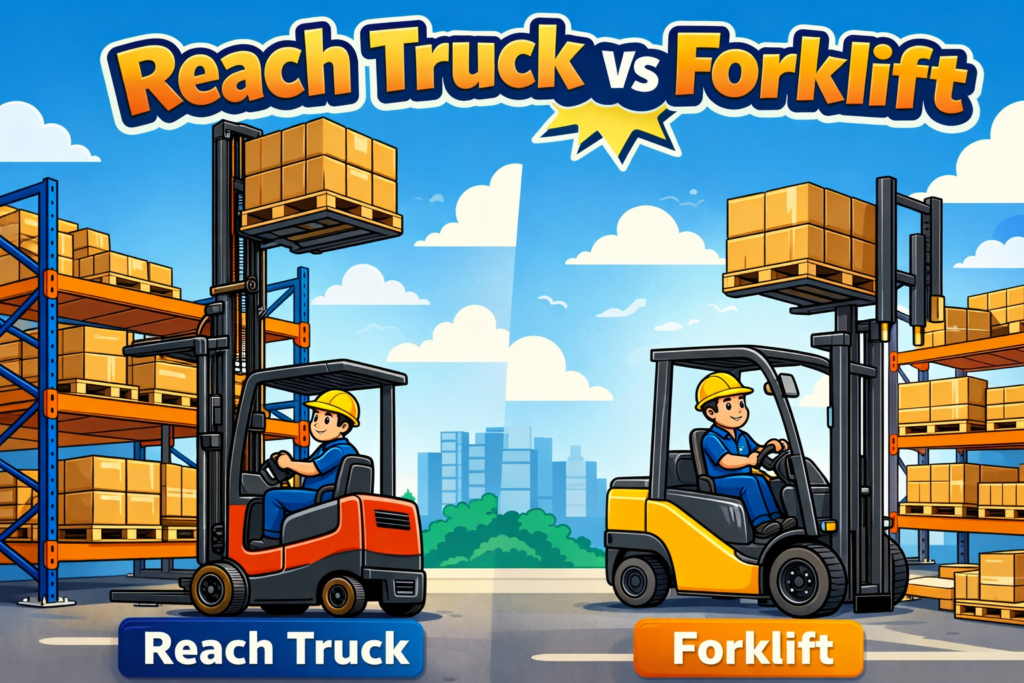
Reach trucks and forklifts serve different purposes in material handling. A reach truck is a specialized electric vehicle built for maximum storage density in narrow-aisle warehouses. Its defining feature is the ability to extend its forks or mast forward while the main body remains stationary. This design allows operators to work in very tight spaces without needing extra room to maneuver. In contrast, a traditional counterbalance forklift drives its entire chassis forward to place or retrieve loads, requiring wider aisles and offering greater overall versatility for both indoor and outdoor tasks.
Reach Truck Key Features
Reach trucks excel in high-density indoor environments. They are almost always electric, feature a standing or sit-down operator position, and use stability legs that straddle the load for excellent balance at height. Their narrow chassis and extending mechanism make them ideal for aisles as tight as 8–9.5 feet. Lift heights often exceed 30–45 feet, allowing warehouses to store more pallets vertically. However, their load capacities are typically lower (2,500–4,500 lbs) because stability and reach are prioritized over raw lifting power.
Forklift (Counterbalance) Key Features
Counterbalance forklifts are the most common and versatile type of forklift. They use a heavy counterweight at the rear to balance loads on the forks and can be powered by electricity, diesel, LPG, or gasoline. These machines are suitable for both indoor and outdoor use, handle heavier loads (commonly 3,000–6,000 lbs, with some models exceeding 100,000 lbs), and require wider aisles (10–12 feet or more). They are faster, more rugged, and better suited for loading/unloading trailers, yard work, and general heavy lifting.
Key Comparison Areas
| Caratteristica | Reach Truck | Forklift (Counterbalance) |
|---|---|---|
| Uso migliore | High-density indoor warehousing | Loading/unloading trailers, outdoor, heavy lifting |
| Aisle Space | Narrow aisles (approx. 8–9.5 ft) | Wider aisles needed (>10–12 ft) |
| Altezza di sollevamento | Excellent for high-reach racking (typically higher) | Good for general purpose, often lower than reach trucks |
| Capacità | Generally lower (2,000–4,500 lbs) | Higher (can exceed 100,000 lbs, typical 3,000–6,000 lbs) |
| Fonte di alimentazione | Always electric | Electric, Diesel, LPG, Gasoline |
| Manovrabilità | Superior in narrow aisles | Better for open areas and outdoor use |
| Operator Position | Standing or sit-down, sideways operation | Sit-down, forward-facing |
| Wheels | Small, hard wheels for smooth floors | Larger pneumatic or cushion tires |
| Efficiency | Maximizes storage density | Prioritizes raw power and versatility |
What Are the Three Types of Forklifts?
Forklifts are generally classified into three main categories: counterbalance forklifts, reach trucks, and martinetti per pallet/order pickers. Counterbalance forklifts are the most common and versatile, used for general material handling both indoors and outdoors. Reach trucks are specialized for narrow-aisle, high-density storage. Pallet jacks and order pickers are smaller machines focused on low-level picking and horizontal transport rather than high lifting. Understanding these distinctions helps warehouses choose the right equipment for their specific layout and operational needs.
Conclusione
Reach trucks and forklifts serve distinct roles in modern warehouses. Reach trucks maximize storage density in narrow aisles with their extending mechanism and high-lift capability, while counterbalance forklifts offer greater versatility, higher load capacities, and outdoor suitability. The choice between them depends on aisle width, lift height requirements, load weights, and whether the operation is primarily indoor or outdoor. Both machines play vital roles in efficient material handling, and many facilities use a combination of both to optimize space and productivity.
 English
  French
  Spanish
  Vietnamese
  Thai
Thai  Italian
  Arabic
  Malay
Malay  Portuguese
  German
  Russian
  Japanese
  Korean
  Lao
Lao