
You can move a small to medium-sized shed with a pallet jack, provided the shed has built-in skids/runners, is empty, and you are moving it across smooth, level ground (like concrete or gravel). Pallet jacks can typically lift 3,000–5,500 lbs, but require rigid flooring for their small wheels, making them unsuitable for soft or uneven dirt.
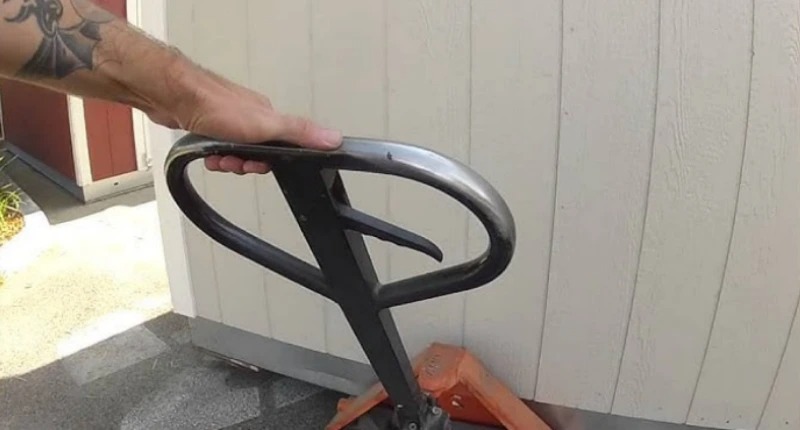
Structure & Skids – The Most Important Requirement
The shed must have solid, built-in wooden or metal skids (runners) on the bottom that create a flat, elevated surface for the pallet jack forks to slide under. Without proper skids, the forks cannot get underneath, and attempting to lift the shed will damage the floor or cause the structure to shift. Most prefabricated garden sheds and storage buildings come with skids, but older sheds or those built on-site often do not. If your shed sits directly on the ground or has only thin floor joists, a pallet jack is not the right tool.
Ground Surface – Where Pallet Jacks Work Best
Pallet jacks perform well only on smooth, hard, level surfaces such as concrete driveways, asphalt, or well-compacted gravel. The small, hard wheels (usually polyurethane or nylon) provide low rolling resistance on flat floors but sink, catch, or lose traction on grass, soft dirt, sand, or any surface with more than a 5% slope. For short distances over concrete or smooth gravel, a pallet jack is often the easiest and cheapest option. For longer distances or uneven terrain, a forklift, trailer, or professional moving company is safer and more efficient.
Weight Check – Know Your Limits
Before attempting any move, calculate the total weight of the empty shed. A typical 8×10 or 8×12 garden shed weighs 800–2,000 lbs when empty. Larger 10×16 or 12×20 sheds can reach 3,000–4,500 lbs. Most standard manual pallet jacks are rated for 4,000–5,500 lbs, while electric models often handle 6,000 lbs or more. Always stay well under the rated capacity (reduce by 20–30% on any incline). Overloading is the most common cause of tipping or jack failure.
Method – Step-by-Step Guide to Moving a Shed
1. Empty the shed completely and remove any shelving or interior fixtures.
2. Inspect and reinforce the skids if necessary.
3. Position the pallet jack so the forks slide fully under the skids from the rear or side.
4. Slowly pump or activate the lift until the shed is 2–4 inches off the ground.
5. Move straight and slowly in short segments, keeping the load centered.
6. Use spotters to guide the movement and watch for obstacles.
7. Lower the shed gently onto its new location and re-level it.
Safety Precautions
Always wear steel-toe boots, gloves, and high-visibility clothing. Never stand directly in front of or behind the moving shed. Use multiple people for control on longer moves. Block the wheels of the pallet jack when stopped. Never attempt the move alone or on windy days. If the shed begins to shift or the jack feels unstable, stop immediately and call professionals.
What’s the Easiest Way to Move a Shed?
For sheds under 2,000 lbs on smooth concrete, a pallet jack is often the easiest and most affordable DIY method. For heavier sheds, longer distances, or any uneven ground, the easiest and safest option is to hire professional shed movers who use specialized dollies, hydraulic lifts, or trailers. They can complete the job in hours with minimal risk to the structure or your property.
Conclusion
You can successfully move a small to medium-sized shed with a pallet jack when the shed has proper skids, is completely empty, and the path is smooth, level concrete or compacted gravel. Understanding weight limits, surface requirements, and correct technique is essential for a safe move. For most homeowners, a pallet jack offers a practical DIY solution for short distances.
 English
  French
  Spanish
  Vietnamese
  Thai
Thai  Italian
  Arabic
  Malay
Malay  Portuguese
  German
  Russian
  Japanese
  Korean
  Lao
Lao  Indonesian
  Turkish
  Irish
Irish  Uzbek
Uzbek