
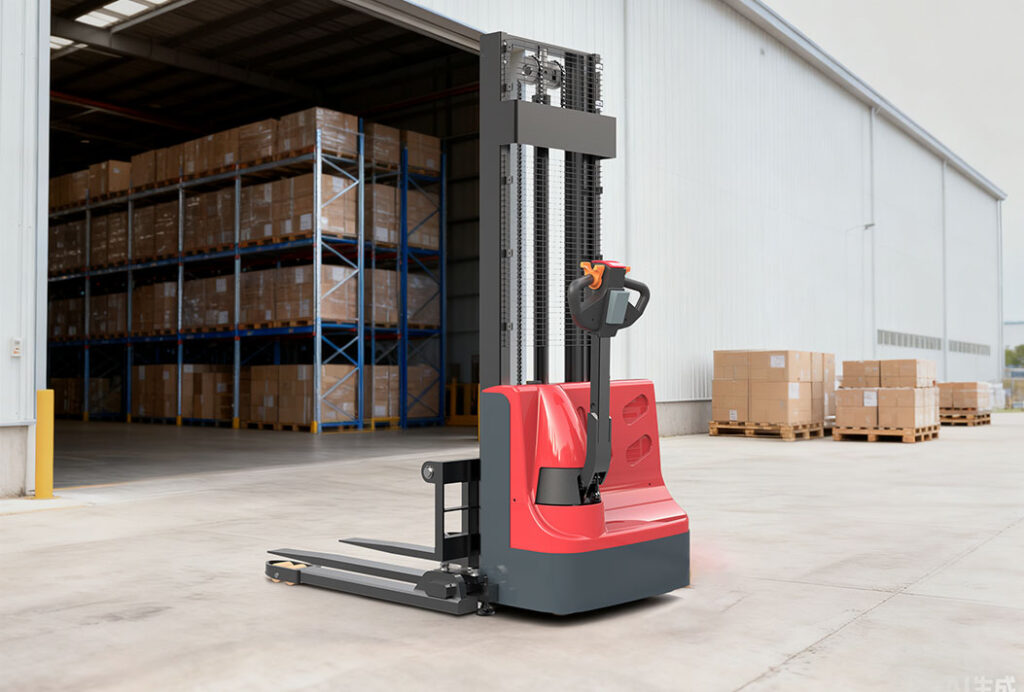
Stackers are material handling vehicles that lift and transport palletized loads horizontally and vertically using a hydraulic mast. Unlike simple pallet jacks, they raise loads for stacking on racking, maximizing warehouse density. Available in manual, semi-electric, or fully powered versions, they handle loads up to 2,200 lb or more.
What Are Stackers and Why Are They Used?
Stackers are compact, efficient material handling machines designed to move and lift palletized loads in warehouses, manufacturing plants, and distribution centers. They bridge the gap between basic pallet jacks and full-size forklifts by offering vertical lifting capability in a smaller, more maneuverable package. Stackers are particularly valuable in facilities with narrow aisles or limited space, where traditional forklifts cannot operate efficiently. Their ability to lift pallets off the floor and place them onto shelving or racking makes them essential for increasing storage density and improving workflow.
How Stackers Work – The Basic Principles
At the core of every stacker is a hydraulic lifting system powered by a mast assembly. The operator positions the forks under a pallet, then activates the hydraulic pump (manually or electrically) to raise the mast and forks. The load is lifted vertically while the base of the stacker remains stable on the floor. Once raised to the desired height, the operator moves the entire unit forward or backward to position the load. Lowering is controlled by a release valve that allows hydraulic fluid to return to the reservoir in a controlled manner. This simple yet effective system enables precise placement of pallets at various heights without requiring a large turning radius.
Lifting Mechanism
The lifting mechanism consists of a telescopic or single-stage mast, hydraulic cylinders, and heavy-duty forks. When the operator activates the lift control, hydraulic fluid is pumped into the cylinders, extending the mast and raising the forks. Most stackers use a chain or direct cylinder system to multiply the lifting force. The design ensures the load remains level and stable throughout the lift. High-quality stackers include load backrests and fork tilt features to secure the load and prevent shifting during movement.
Power Types
Stackers are available in three main power configurations:
- Manual Stackers: Operated by a hand pump or foot pedal. Ideal for light-duty, low-volume applications where cost and simplicity are priorities.
- Semi-Electric Stackers: Use electric lifting motors while the operator walks and pushes the unit. They combine the convenience of powered lifting with low operating costs.
- Fully Powered Stackers: Feature electric drive motors for both lifting and propulsion. These are the most productive and least physically demanding, suitable for higher-volume operations.
Maneuverability
Stackers are highly maneuverable due to their compact size and short wheelbase. Most models can turn within their own length, making them perfect for narrow aisles. The operator walks alongside the machine (or rides on a platform in rider versions), maintaining excellent visibility of the load and surroundings. This design allows precise positioning in tight spaces where a standard forklift would be too large or cumbersome.
Safety Features
Modern stackers incorporate multiple safety systems. Automatic braking activates when the operator releases the control handle. Many models include an emergency stop button, overload protection, and speed reduction when the mast is raised. Stability legs or outriggers provide additional balance during lifting. Operators are required to complete proper training and certification before using these machines, as they are classified as powered industrial trucks under OSHA regulations.
How to Operate a Stacker
1. Perform a pre-operation inspection of the forks, mast, wheels, and hydraulic system.
2. Approach the pallet straight on and position the forks fully under the load.
3. Activate the lift control to raise the pallet just enough to clear the ground.
4. Move the stacker slowly to the desired location while keeping the load low.
5. Position the stacker squarely in front of the racking.
6. Lift the load to the required height and gently place it on the rack beams.
7. Retract the forks carefully and lower them before backing away.
8. Always keep the load centered, travel slowly, and never exceed the rated capacity.
Conclusion
Stackers are versatile, space-efficient material handling vehicles that combine horizontal transport with vertical lifting capability. Their hydraulic mast, various power options, and compact design make them ideal for warehouses with narrow aisles and high storage needs. Understanding how stackers work — from their lifting mechanism and power systems to safe operating procedures — helps operators and managers maximize productivity while maintaining a safe work environment.
 English
  French
  Spanish
  Vietnamese
  Thai
Thai  Italian
  Arabic
  Malay
Malay  Portuguese
  German
  Russian
  Japanese
  Korean
  Lao
Lao