
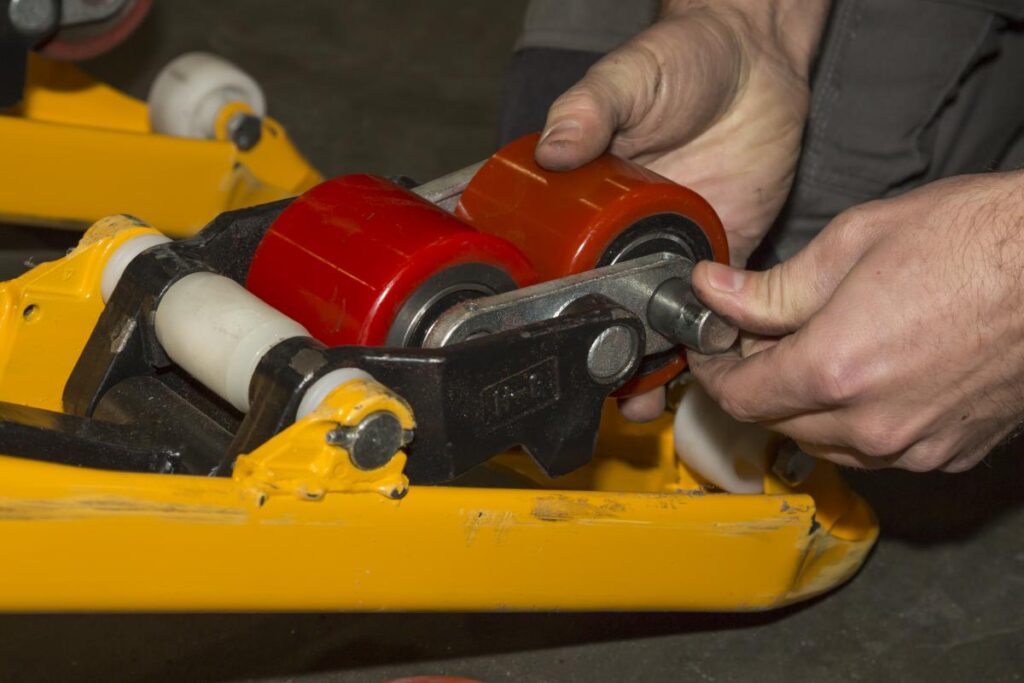
Replacing load wheels on a pallet jack involves flipping the unit (or propping it up), driving out the locking pins with a punch, removing the axle, and replacing the wheels and bearings. Always replace wheels in pairs, ensuring the new wheels are properly lubricated and locked into place with new pins.
Why Replace Load Wheels on a Pallet Jack?
Worn or damaged load wheels are one of the most common reasons xe nâng pallet become difficult to maneuver. Cracked, flat, or seized wheels cause excessive noise, poor steering, increased operator fatigue, and potential damage to floors. Replacing them restores smooth rolling, improves safety, and extends the overall life of the equipment. Most load wheels can be replaced in under an hour with basic tools, making this a cost-effective maintenance task that pays for itself quickly through better productivity.
Tools Required
Before starting, gather the following tools and supplies:
- Hammer and pin punch (or drift punch)
- Pliers or retaining ring pliers
- Replacement load wheels (matched pair with new bearings if needed)
- Grease or wheel bearing lubricant
- Safety glasses and work gloves
- Jack stands or blocks to support the pallet jack
- Optional: floor jack for easier lifting
Step-by-Step Replacement Procedure
1. Secure the Pallet Jack
Park the xe nâng pallet on a flat, level surface. Lower the forks completely and engage any parking brake if equipped. For safety, chock the drive wheel to prevent rolling. If possible, flip the entire unit onto its side or use sturdy blocks to raise the load wheels off the ground. Never work under the jack while it is supported only by the forks.
2. Remove Locking Pins
Locate the axle locking pins or retaining clips on both sides of the load wheel assembly. Use a hammer and punch to drive out the pins. Work carefully to avoid damaging the axle or frame. Place the removed pins in a safe location so they are not lost. Some models use snap rings or circlips — use pliers designed for retaining rings to remove them.
3. Remove the Axle
Slide the axle out from one side. Support the wheels as you remove the axle so they do not fall. Inspect the axle for wear, scoring, or bending. If the axle shows damage, it should be replaced along with the wheels.
4. Remove Old Wheels
Slide the old wheels off the axle. Clean the axle thoroughly and inspect the bearings inside the wheel hubs. If the bearings are worn, noisy, or feel gritty, replace them at the same time. Discard the old wheels responsibly — many facilities have recycling programs for polyurethane and nylon wheels.
5. Install New Wheels
Apply a generous amount of grease to the new bearings and axle. Slide the new wheels onto the axle in the correct orientation. Ensure the wheels spin freely and without binding. Reinstall the axle through the frame and wheels.
6. Secure with New Pins
Insert new locking pins or retaining clips on both ends of the axle. Tap them gently into place until fully seated. Double-check that the wheels cannot slide off the axle and that the pins are secure.
7. Final Inspection
Lower the xe nâng pallet back to the ground. Roll it back and forth to confirm smooth, quiet operation. Check that both wheels rotate evenly and that there is no side-to-side play. Test the steering and braking functions before returning the jack to service.
Lời khuyên về an toàn và các phương pháp hay nhất
Always wear safety glasses and gloves when working on a pallet jack. Never work under an unsupported jack. Replace wheels in pairs to maintain even performance and prevent steering pull. Use only manufacturer-recommended wheel sizes and load ratings. After replacement, test the jack with a light load before using it with full capacity. Keep a spare set of load wheels on hand to minimize downtime.
When to Replace Instead of Repair
If the frame is bent, the axle is damaged, or the wheels have worn multiple times in a short period, consider replacing the entire load wheel assembly or the xe nâng pallet itself. Modern electric models offer improved wheel durability and lower overall maintenance costs.
Kết luận
Replacing load wheels on a pallet jack is a straightforward maintenance task that restores smooth operation and prevents further damage to floors and the equipment itself. By following the step-by-step process — securing the jack, removing old components, installing new wheels, and performing a final inspection — you can complete the job quickly and safely. Regular wheel replacement is one of the easiest ways to keep your pallet jack performing at its best.
 English
  French
  Spanish
  Vietnamese
  Thai
Thai  Italian
  Arabic
  Malay
Malay  Portuguese
  German
  Russian
  Japanese
  Korean
  Lao
Lao  Indonesian
  Turkish
  Irish
Irish  Uzbek
Uzbek