
A pallet jack, also known as a pallet truck or pump truck, is a fundamental, manually operated (or electric) tool designed to lift and transport heavy palletized loads over short distances. Essential for warehouses and retail, they use a hydraulic pump and two forks to lift pallets, typically carrying up to 5,500 pounds in narrow spaces where forklifts cannot operate.
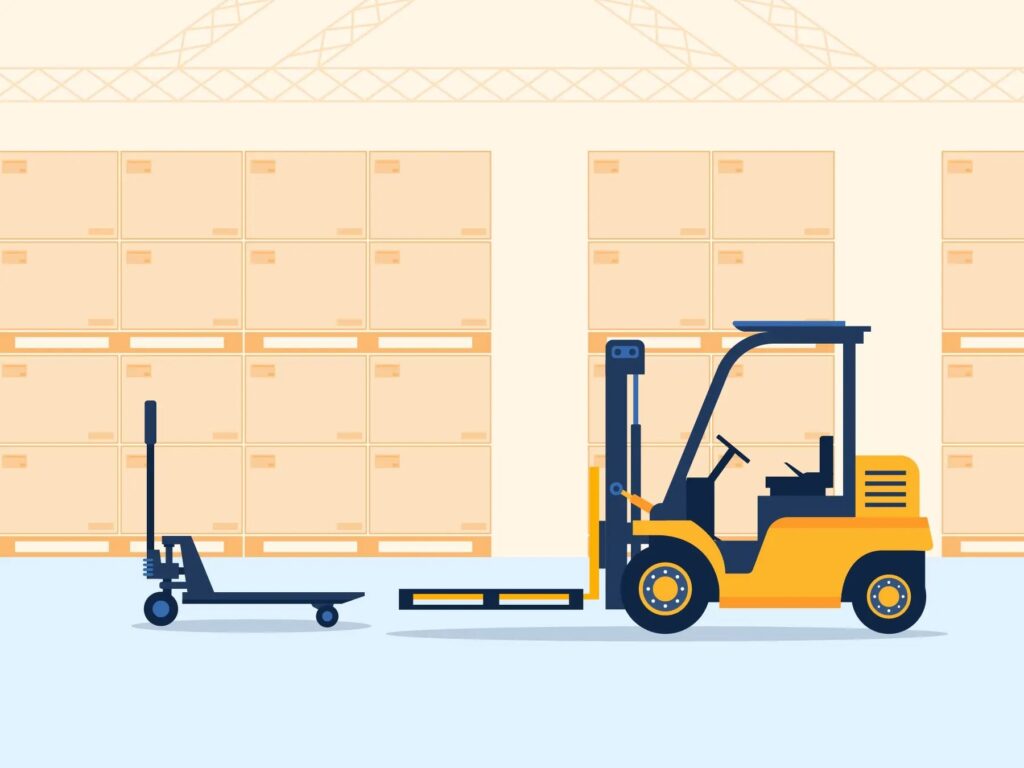
What Is the Purpose of a Pallet Jack?
The primary purpose of a pallet jack is to move palletized goods efficiently and safely over short distances within warehouses, retail stores, loading docks, and manufacturing facilities. Unlike larger equipment, pallet jacks are compact, highly maneuverable, and ideal for tight aisles and confined spaces where full-sized forklifts cannot operate. They allow a single operator to lift, transport, and position heavy pallets quickly, improving workflow, reducing physical strain, and increasing productivity in material handling environments.
What Is the Difference Between a Forklift and a Pallet Jack?
| Feature | Pallet Jack | Forklift |
|---|---|---|
| Lift Height | Only a few inches (usually 3–8 inches) | Up to 20+ feet (high stacking) |
| Capacity | Typically 4,000–5,500 lbs | 3,000–36,000+ lbs |
| Operation | Walk-behind or stand-up rider | Sit-down or stand-up rider |
| Best For | Short-distance horizontal transport in tight spaces | High stacking, loading docks, heavy lifting |
| Maneuverability | Excellent in narrow aisles | Larger turning radius |
Types of Pallet Jacks
Pallet jacks come in two main categories:
- Manual Pallet Jacks: Operated by pumping the handle to lift the load. Simple, affordable, and ideal for light to medium-duty tasks.
- Electric Pallet Jacks: Powered by a battery and electric motor. They reduce operator effort and are perfect for high-volume operations or heavier loads.
How a Pallet Jack Works
The operator inserts the forks fully under the pallet, lowers the control lever to engage the hydraulic system, and pumps the handle to lift the load. Steering is done by the long handle, and lowering is achieved by squeezing the release lever. The hydraulic pump creates pressure that raises the forks, while gravity lowers them when released.
Conclusion
A pallet jack is an essential, versatile tool for moving palletized goods efficiently in tight spaces where larger equipment cannot go. Understanding its purpose, how it differs from a forklift, and proper operation helps improve safety and productivity in any warehouse or retail environment. Whether you choose a simple manual model or a powerful electric version, a pallet jack remains one of the most practical and cost-effective material handling solutions available today.