
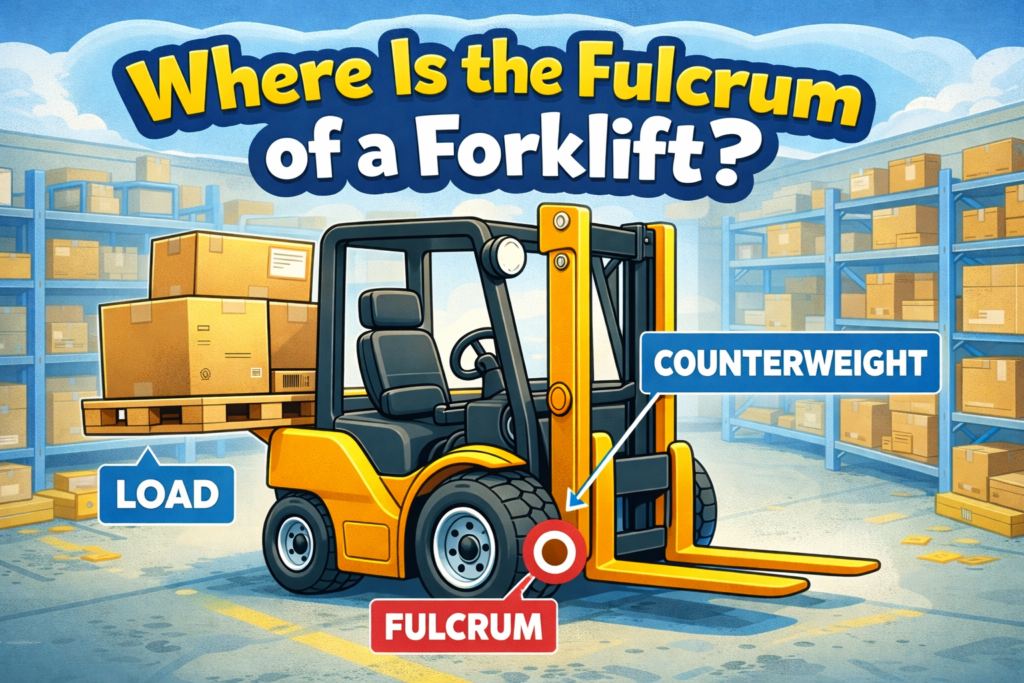
The fulcrum of a forklift is located at the center of the front axle/wheels. It acts as the pivot point (like a seesaw) where the machine’s counterweight balances the load on the forks. If the load’s center of gravity passes this point, the forklift may tip forward. Understanding the fulcrum is essential for safe operation and preventing accidents.
What Is the Fulcrum on a Forklift?
The fulcrum is the imaginary pivot line running through the center of the front wheels or axle. It serves as the balance point for the entire machine. Just like a seesaw, everything in front of this line tries to tip the forklift forward, while the heavy counterweight at the rear tries to keep it stable. The operator must keep the combined center of gravity of the forklift and the load behind this fulcrum at all times. When the load’s center of gravity moves too far forward, the forklift becomes unstable and can tip over, which is one of the leading causes of serious forklift accidents.
The Stability Triangle Explained
Forklift stability is based on a “stability triangle” formed by the two front wheels and the center of the rear axle. The fulcrum line runs across the front of this triangle. As long as the combined center of gravity stays inside the triangle, the forklift remains stable. Raising the load, tilting the mast forward, turning sharply, or driving on uneven surfaces can shift the center of gravity outside the triangle, causing a tip-over. The lower and closer to the mast the load is kept, the safer the forklift remains.
Load Center and Its Relationship to the Fulcrum
The load center is the horizontal distance from the face of the forks to the center of gravity of the load. Most forklifts are rated for a 24-inch load center. If the load extends farther out (for example, when picking up a long or uneven pallet), the effective center of gravity moves forward toward the fulcrum. This reduces the safe lifting capacity and increases tipping risk. Operators must always check the load center rating on the forklift’s nameplate and never exceed it. Placing the load as close as possible to the carriage backrest helps keep the center of gravity safely behind the fulcrum.
Forward Point of Balance on a Forklift
The forward point of balance is located at the fulcrum — the centerline of the front axle. This is the critical tipping point. Any time the center of gravity of the load and forklift moves in front of this line, the rear wheels begin to lift and the forklift tips forward. This is why operators are trained to keep forks low and tilted back during travel and to avoid sudden stops or sharp turns with an elevated load. Understanding this forward point of balance is fundamental to safe forklift operation and is a key topic covered in every OSHA-compliant training program.
Safety Rules Based on the Fulcrum Principle
All safe forklift practices revolve around keeping the center of gravity behind the fulcrum:
- Travel with forks as low as possible (4–6 inches off the ground)
- Tilt the mast back slightly to cradle the load
- Never turn with the load raised high
- Slow down on ramps and uneven surfaces
- Never allow anyone to stand under a raised load
These rules exist because once the forklift starts to tip past the fulcrum, recovery is nearly impossible. The operator must remain inside the compartment and lean away from the direction of the fall rather than jumping clear.
Common Mistakes That Shift the Center of Gravity
Many tip-over incidents occur because operators unknowingly move the center of gravity past the fulcrum:
- Raising the load too high while traveling
- Tilting the mast forward while moving
- Taking corners too fast with an elevated load
- Carrying unbalanced or off-center loads
- Driving on ramps with the load facing downhill
Training and constant awareness help operators avoid these dangerous habits. Many modern forklifts include stability control systems that automatically limit speed or lift height when the center of gravity approaches the fulcrum line.
Conclusion
The fulcrum of a forklift is located at the center of the front axle and serves as the critical balance point between the load and the rear counterweight. Every safe operating practice is designed to keep the combined center of gravity behind this line. By maintaining low forks, proper mast tilt, controlled speeds, and correct load positioning, operators can prevent tip-overs and work efficiently. Understanding the fulcrum, stability triangle, and load center is fundamental training for every forklift operator and remains one of the most important safety concepts in material handling.