
Pallet jacks can go up a ramp, but with limitations. Manual pallet jacks are best suited for slopes under 10–12%, while electric models can generally handle up to 15%. Always move straight up/down, keep the load uphill, and use a slow, controlled pace to avoid losing control or causing the load to tip.
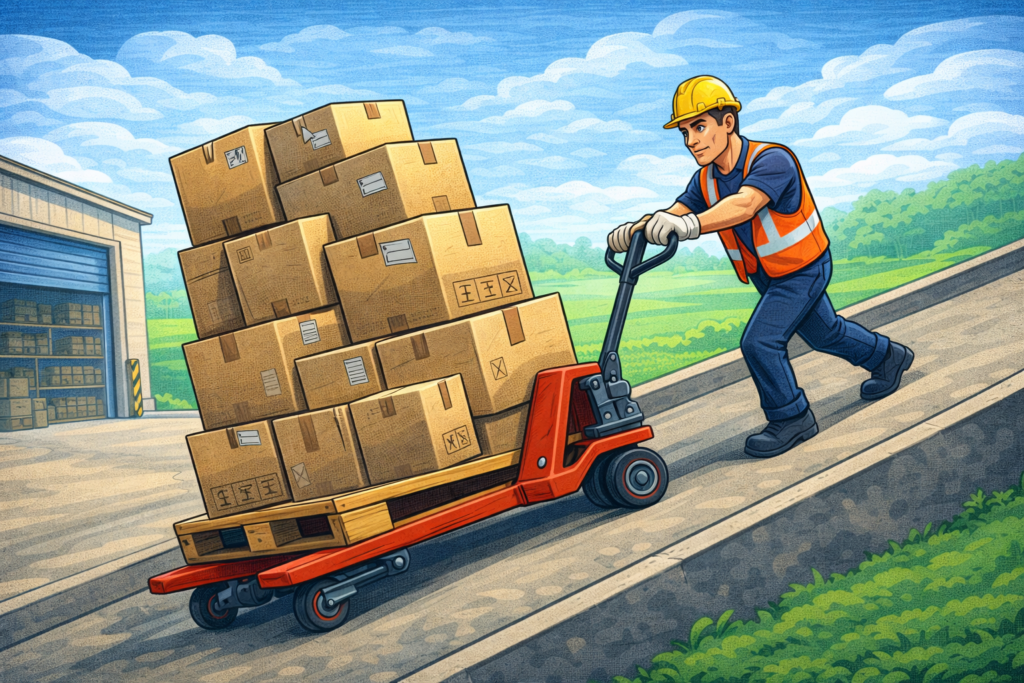
Can You Use a Pallet Jack Up a Ramp?
Yes, pallet jacks can be used on ramps, but only within strict manufacturer limits and with proper technique. Standard manual pallet jacks are designed primarily for flat, level surfaces inside warehouses. When used on ramps, the risk of tipping, load shifting, or loss of control increases dramatically. Electric pallet jacks, especially stand-up and ride-on models, offer better stability and power on moderate inclines, but even they have clear maximum slope ratings. Exceeding these limits is dangerous and can void warranties or lead to serious injuries.
What Is the Maximum Slope for a Pallet Jack?
The safe maximum slope depends on the type of pallet jack and the load weight:
- Manual Pallet Jacks: Generally limited to 5–10% grade (about 3–6 degrees). Some heavy-duty models are rated up to 12% when lightly loaded.
- Electric Walk-Behind Pallet Jacks: Usually safe up to 10–12% with a full load; some models reach 15% when empty or lightly loaded.
- Stand-Up / Rider Electric Pallet Jacks: Often rated for 12–15% inclines thanks to powerful motors and wider wheelbases.
- All-Terrain / Rough-Terrain Pallet Jacks: Can handle up to 15–20% on gravel or dirt ramps with proper tires.
Always check the specific model’s nameplate or owner’s manual for the exact rating. Never assume a higher slope is safe just because the jack “feels” capable.
Key Considerations and Safety Tips
1. Load Position and Weight Distribution
Keep the load centered on the forks and as low as possible (forks raised only 4–6 inches). When going uphill, position the load uphill so the weight helps stabilize the jack. When going downhill, keep the load downhill to maintain control.
2. Speed and Direction
Move straight up or down the ramp — never at an angle. Use a slow, steady walking pace. Sudden stops or sharp turns on a slope can cause the jack to tip or the load to slide off the forks.
3. Ramp Surface and Condition
The ramp must be clean, dry, and free of debris, oil, or ice. Rough or damaged ramps increase the chance of the wheels catching or losing traction. For outdoor ramps, all-terrain models with pneumatic tires are strongly recommended.
4. Operator Technique
Stand to the side of the jack (never directly behind or in front) when on a ramp. Use both hands on the handle for maximum control. For electric models, keep one hand on the control handle and the other on the emergency stop or brake if equipped.
5. Capacity and Load Limits
Reduce the maximum rated capacity by 20–30% when operating on any incline. A 5,000 lb rated manual jack may only safely carry 3,500–4,000 lbs on a ramp.
Best Practices for Safe Ramp Use
Before using any ramp, inspect it for damage and measure the slope with a digital inclinometer or smartphone app. If the slope exceeds the manufacturer’s rating, use alternative equipment such as a forklift, pallet truck with ramp assistance, or a loading dock leveler. Train all operators on ramp safety procedures and never allow untrained staff to move loads on inclines.
Conclusion
Pallet jacks can safely go up a ramp when the slope stays within the manufacturer’s limits and proper technique is followed. Manual models are generally restricted to 10–12% grades, while electric and all-terrain models can handle up to 15% or more. Always keep the load low, move straight, reduce speed, and never exceed the rated capacity on an incline. Following these guidelines prevents tipping, load loss, and serious injuries.
 English
  French
  Spanish
  Vietnamese
  Thai
Thai  Italian
  Arabic
  Malay
Malay  Portuguese
  German
  Russian
  Japanese
  Korean
  Lao
Lao  Indonesian
  Turkish
  Irish
Irish  Uzbek
Uzbek