
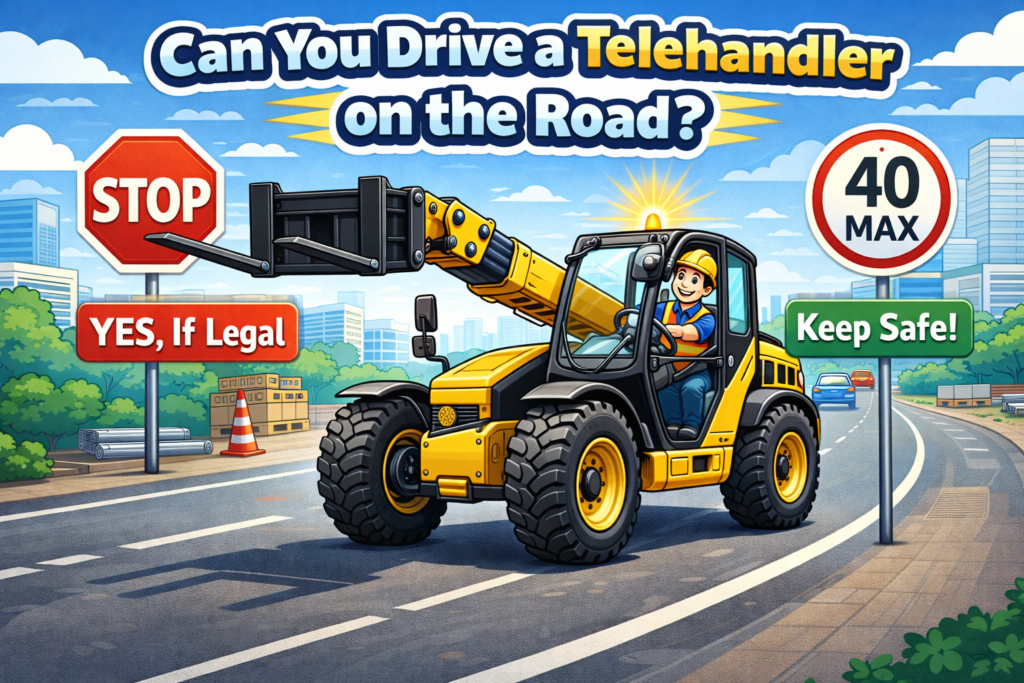
Yes, you can drive a telehandler on the road, but only if it is registered, insured, and properly equipped with road-safety features like lights and signals. It generally must be for short distances between sites or for agricultural use. The driver must have a valid driver’s license (often Category B or F) and the machine must display a slow-moving vehicle (SMV) sign.
Legal Requirements for Road Use
Driving a telehandler on public roads is permitted in many jurisdictions, but it is heavily regulated. Telehandlers are classified as specialized construction or agricultural equipment rather than standard motor vehicles. In the United States, they are often treated as slow-moving vehicles and must comply with state-specific rules for registration, lighting, and signage. In Europe, many countries classify them under agricultural or construction vehicle categories, requiring specific licensing and equipment standards. Always check local regulations before taking a telehandler on public roads, as rules vary significantly by country, state, or even municipality.
Registration and Insurance
Most regions require telehandlers to be registered with the department of motor vehicles or equivalent authority if they will travel on public roads. Registration typically involves obtaining a special plate or slow-moving vehicle emblem. Insurance is mandatory and must cover both the machine and third-party liability. Standard auto insurance policies usually do not cover telehandlers, so specialized equipment insurance is necessary. Without proper registration and insurance, operating a telehandler on the road can result in fines, impoundment, or legal liability in the event of an accident.
Equipment Requirements
To be road-legal, a telehandler must be fitted with specific safety equipment. This includes:
- Working headlights, taillights, brake lights, and turn signals
- Reflectors and a slow-moving vehicle (SMV) triangle sign
- Horn and warning beacons (in many jurisdictions)
- Properly inflated tires with adequate tread depth
- Securely fastened mirrors for visibility
Some models come factory-equipped for road use, while others require aftermarket modifications. The machine must also meet weight and width restrictions for the roads it will travel on.
Safety Precautions When Driving on the Road
Telehandlers are not designed for high-speed or long-distance road travel. They have a high center of gravity, limited visibility, and slower acceleration compared to regular vehicles. Key safety practices include:
- Drive at reduced speeds, typically under 25 mph
- Avoid highways and busy roads whenever possible
- Use hazard lights and maintain extra following distance
- Plan routes to minimize time on public roads
- Ensure the operator is properly licensed and trained
Only qualified and experienced operators should drive a telehandler on public roads.
Speed Limitations and Practical Considerations
Speed limits for telehandlers on public roads are usually much lower than for passenger vehicles. Many jurisdictions cap the speed at 20–25 mph, and some require escort vehicles for longer transports. Because telehandlers are tall and have a long boom, they are more susceptible to wind and uneven road surfaces. Operators must remain vigilant for overhead obstacles, narrow bridges, and low-hanging wires. For longer distances, it is often safer and more practical to transport the telehandler on a trailer rather than driving it on the road.
Are Telescopic Handlers Street Legal?
Telescopic handlers (telehandlers) can be street legal when properly equipped and registered. However, they are not intended for regular road use like a truck or car. Most manufacturers design them primarily for off-road or job-site operation. Road legality depends on meeting local equipment standards and obtaining the necessary permits. In many cases, short-distance moves between nearby job sites are allowed, but long-distance travel on public roads is discouraged or restricted.
What Category Is a Telehandler In?
Telehandlers are typically categorized as agricultural or construction equipment. In the United States, they fall under the broad classification of powered industrial trucks or specialized mobile equipment. In Europe, they are often placed in Category F (agricultural) or Category B (construction) for licensing purposes. The exact category determines the required driver’s license and equipment standards. Always confirm the classification with your local transportation authority before operating on public roads.
Conclusione
You can drive a telehandler on the road under specific conditions, but it requires proper registration, insurance, lighting, and safety equipment. The machine must comply with local regulations regarding speed, signage, and operator licensing. While short moves between job sites are often permitted, telehandlers are not designed for regular road travel. Prioritizing safety, following manufacturer guidelines, and using a trailer for longer distances is the recommended approach.
 English
  French
  Spanish
  Vietnamese
  Thai
Thai  Italian
  Arabic
  Malay
Malay  Portuguese
  German
  Russian
  Japanese
  Korean
  Lao
Lao  Indonesian
  Turkish
  Irish
Irish  Uzbek
Uzbek