
A reach truck is a specialized warehouse forklift designed for narrow aisles, using a hydraulic pantograph mechanism or moving mast to extend its forks forward for picking loads while keeping the center of gravity within its wheelbase. It uses outrigger legs and rear-steer wheels to maximize stability and maneuverability, allowing it to lift heavy goods to high, narrow warehouse racks.
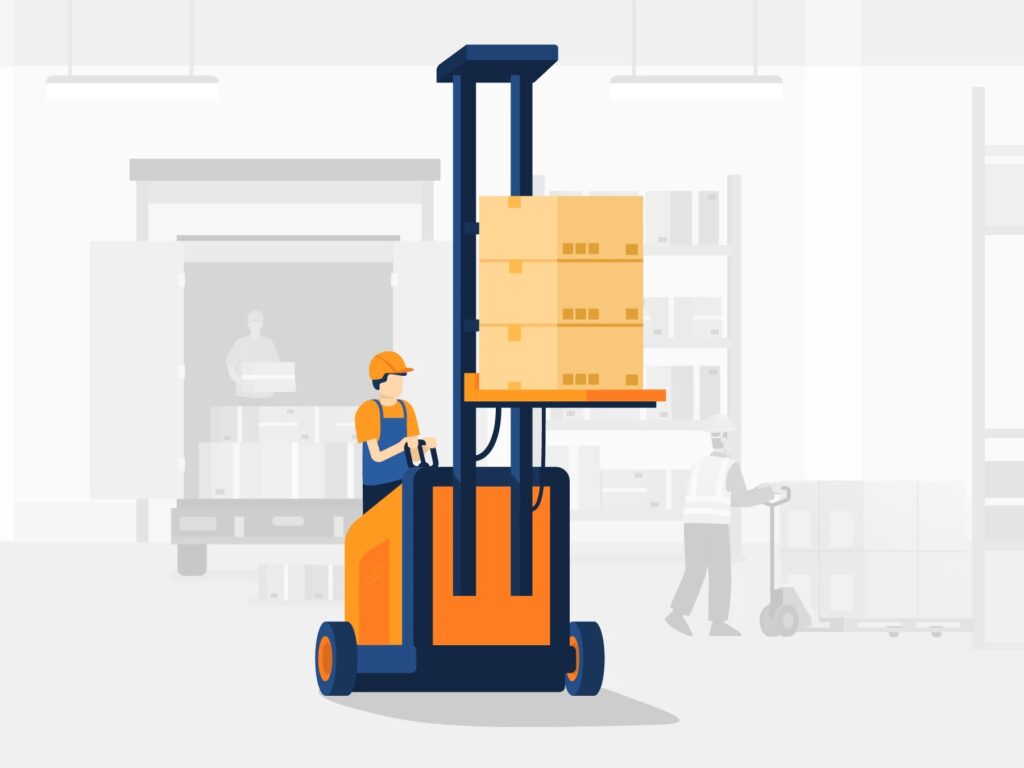
What Is a Reach Truck and Why Is It Used?
Reach trucks are engineered specifically for high-density storage in warehouses where space is limited. Unlike 카운터 밸런스 지게차 that need wide aisles to turn, reach trucks operate in aisles as narrow as 8–9 feet. Their unique design allows the forks to extend forward to pick or place pallets deep inside racking while the main body of the truck remains stationary. This capability dramatically increases storage density and improves warehouse efficiency. Reach trucks are the preferred choice in distribution centers, cold storage facilities, and manufacturing plants where maximizing cubic storage space is critical.
Main Types of Reach Trucks
Moving Mast Reach Trucks
In a moving mast reach truck, the entire mast assembly slides forward on rails. This design offers excellent visibility and stability. The operator has a clear view of the forks throughout the reach cycle. Moving mast models are popular in high-lift applications because the mast can extend very high while maintaining a compact footprint.
Pantograph (Fork-Only) Reach Trucks
Pantograph reach trucks use a scissor-like mechanism that extends only the forks forward. The mast itself stays in place. This design is more compact and allows the truck to operate in even narrower aisles. Pantograph models are often lighter and more maneuverable, making them ideal for very tight warehouse layouts.
Double-Reach Trucks
Double-reach trucks extend the forks in two stages, allowing them to reach the second pallet deep in a rack. This capability is valuable in warehouses using deep-reach racking systems, further increasing storage density without widening aisles.
Key Components & Operation
The Reach Mechanism
The reach mechanism is the heart of the machine. Hydraulic cylinders power either the moving mast or the pantograph arms. When the operator activates the reach control, the forks glide forward smoothly while the main body of the truck stays anchored on its outrigger legs. This separation of movement keeps the center of gravity safely within the wheelbase, even when the forks are fully extended with a heavy load.
Outrigger Legs
Outrigger legs (also called straddle legs) extend forward on either side of the forks. They provide the wide, stable base needed for safe operation in narrow aisles. The truck’s drive wheels are located at the rear, and the outriggers support the load when the forks are extended. This design allows the reach truck to lift heavy loads without the need for a large counterweight at the back.
Stand-Up Cabin
Most reach trucks feature a stand-up operator compartment. The operator stands on a platform with excellent visibility in all directions. Modern models include ergonomic controls, cushioned floors, and adjustable backrests to reduce fatigue during long shifts. Some high-end units offer enclosed cabs with heating or air conditioning for extreme environments.
컨트롤
Controls are intuitive and placed for easy reach. A steering tiller or wheel controls direction, while separate levers or joysticks handle lift, lower, reach, and tilt functions. Many modern reach trucks include electronic controls with programmable performance settings that allow managers to adjust speed and acceleration based on operator skill level or warehouse requirements.
Reach Trucks vs. Other Forklifts
Compared to 카운터 밸런스 지게차, reach trucks require much less aisle width and provide higher storage density. They are not designed for outdoor use or rough terrain. Their specialized nature makes them the most efficient choice for indoor, high-rack warehousing but limits their versatility in mixed environments.
결론
A reach truck works by using a sophisticated reach mechanism — either a moving mast or pantograph system — to extend the forks forward while keeping the main body of the machine stable on its outrigger legs. This unique design allows it to operate efficiently in very narrow aisles and reach high into racking systems. Understanding the different types, key components, and operating principles helps warehouse managers select the right equipment and train operators effectively.
 English
  French
  Spanish
  Vietnamese
  Thai
Thai  Italian
  Arabic
  Malay
Malay  Portuguese
  German
  Russian
  Japanese
  Korean
  Lao
Lao  Indonesian
  Turkish
  Irish
Irish  Uzbek
Uzbek