
A reach truck is a specialized electric warehouse forklift designed for narrow aisles and high-bay racking. It extends its forks forward to pick loads without moving the entire vehicle, making it ideal for high-lift tasks up to 45 feet on smooth indoor floors.
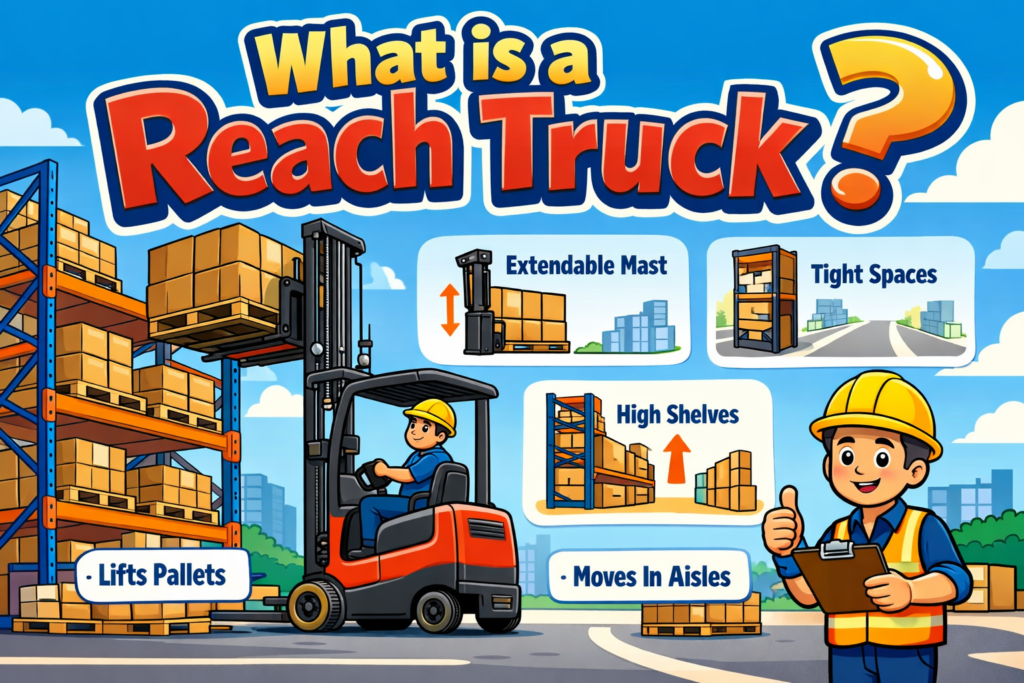
What Is a Reach Truck?
A reach truck is a highly specialized type of forlikt elektrik engineered for maximum storage density in warehouses. Unlike standard forlikt imbangan that must drive forward to place or retrieve loads, a reach truck keeps its chassis stationary while the forks or mast extend outward. This unique design allows operators to work in extremely narrow aisles — often as tight as 8 to 10 feet — while still reaching deep into high-bay racking systems. Reach trucks are a cornerstone of modern high-density warehousing because they combine impressive lift heights with exceptional maneuverability in confined spaces.
Jenis Utama Kereta Jangkauan
Trak Jangkauan Tiang Bergerak
The most common type features a mast that moves forward and backward on rails. The entire mast assembly extends to reach into the racking, providing excellent stability and visibility. These trucks are popular in facilities with uniform pallet sizes and consistent load weights.
Pantograph Reach Trucks (Single-Deep and Double-Deep)
Pantograph models use a scissor-like mechanism to extend the forks. Single-deep versions reach one pallet deep, while double-deep models can access the second pallet position without moving the truck. Double-deep pantograph reach trucks are especially valued in high-density storage environments where every inch of space matters.
Four-Directional Reach Trucks
These advanced models can travel sideways as well as forward and backward. The ability to move laterally makes them extremely efficient in very narrow aisles and when handling long loads such as lumber or piping. Four-directional reach trucks maximize warehouse space utilization in facilities with unique storage requirements.
Key Features and Purpose of Reach Trucks
Narrow Aisle Operation
Reach trucks excel in aisles as narrow as 8–9 feet. Their compact chassis and extending mechanism allow operators to work efficiently without needing extra space to maneuver, significantly increasing the amount of usable storage space compared to traditional forklifts.
High Lift Capability
Most reach trucks can lift loads up to 30–45 feet, making them ideal for tall racking systems. This high-reach capability, combined with precise fork positioning, enables warehouses to store more pallets vertically and maximize cubic storage capacity.
Forward Reach Mechanism
The defining feature is the ability to extend the forks or mast forward while the truck body remains stationary. This design reduces the turning radius and eliminates the need to drive into the racking, improving both safety and speed during picking and placing operations.
Stability Legs
Reach trucks use outrigger-style stability legs that straddle the load. These legs provide excellent lateral stability during lifting and reaching, allowing the truck to handle heavy loads at height without tipping.
High Operator Visibility
Because the operator sits or stands behind the mast, visibility is generally better than on counterbalance forklifts. Many models include panoramic operator cabs and cameras to further enhance safety when working at height.
Limitations of Reach Trucks
Indoor Only
Reach trucks are designed exclusively for smooth, level indoor floors. Their small wheels and low ground clearance make them unsuitable for outdoor use, rough terrain, or uneven surfaces.
Lighter Load Capacities
Compared to standard forklifts, reach trucks typically have lower load capacities — commonly 2,500 to 4,500 lbs — because stability is prioritized over raw lifting power. They are optimized for density and height rather than heavy-duty outdoor lifting tasks.
What Is the Difference Between a Forklift and a Reach Truck?
The main difference lies in their design and intended use. A traditional forklift drives its entire body forward to place or retrieve loads, requiring wider aisles. A reach truck stays in place and extends its forks or mast, allowing operation in much narrower aisles. Forklifts are more versatile for outdoor and heavy-duty applications, while reach trucks are specialized for high-density indoor warehousing where maximizing storage space is the priority.
Kesimpulan
A reach truck is a purpose-built electric warehouse vehicle that dramatically increases storage density by operating in very narrow aisles and reaching high into racking systems. Its forward-reaching mechanism, stability legs, and high-lift capability make it an indispensable tool for modern distribution centers and manufacturing facilities. Understanding the different types — moving mast, pantograph, and four-directional — helps operators and warehouse managers select the right model for their specific needs. While reach trucks are limited to indoor, smooth-floor environments and generally carry lighter loads than standard forklifts, their ability to maximize vertical and horizontal space makes them one of the most efficient material handling solutions available today.
 English
  French
  Spanish
  Vietnamese
  Thai
Thai  Italian
  Arabic
  Malay
Malay  Portuguese
  German
  Russian
  Japanese
  Korean
  Lao
Lao  Indonesian
  Turkish
  Irish
Irish  Uzbek
Uzbek