
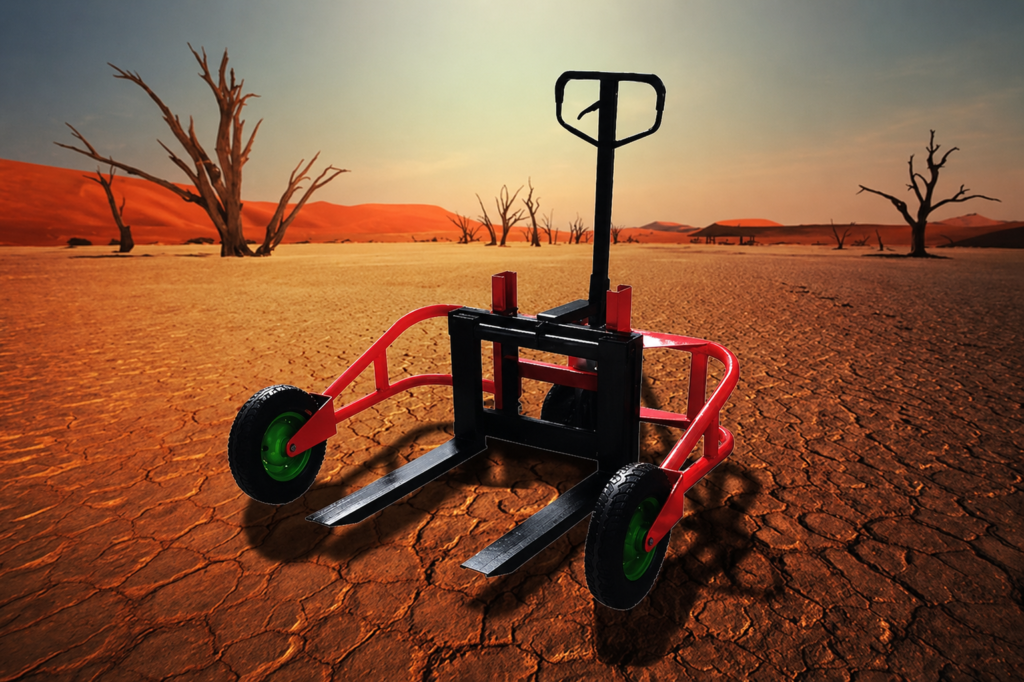
Standard pallet jacks are not designed to operate on dirt. They require smooth, flat surfaces such as concrete or warehouse flooring. However, specialized all-terrain pallet jacks with large pneumatic tires and reinforced frames can effectively handle dirt, gravel, grass, and other uneven outdoor surfaces.
Why Standard Pallet Jacks Struggle on Dirt
Most warehouse pallet jacks are built for indoor use on hard, level floors. Their small, hard polyurethane or nylon wheels have very little ground clearance and poor traction on soft or loose surfaces. When driven onto dirt, these small wheels quickly sink, making it extremely difficult to move the load. The narrow wheelbase also reduces stability on uneven ground, increasing the risk of tipping or getting stuck.
All-Terrain Pallet Jacks: Designed for Outdoor Work
Specialized all-terrain pallet jacks solve these problems with larger, air-filled (pneumatic) tires, higher ground clearance, and stronger frames. These models are specifically engineered for construction sites, nurseries, farms, and outdoor storage yards where dirt, gravel, or grass is common. The bigger tires distribute weight more evenly and provide much better traction on soft ground.
Key Considerations for Operating on Dirt
All-Terrain Models
If you frequently need to move pallets on dirt or gravel, investing in a true all-terrain pallet jack is essential. These units typically feature large pneumatic tires (often 16–20 inches), wider wheelbases for stability, and reinforced forks and frames to handle the extra stress of outdoor use.
Manual vs. Powered Options
Manual all-terrain pallet jacks can handle lighter loads on relatively flat dirt surfaces. However, for heavier loads or when working on slopes and softer ground, powered models (electric, gas, or propane) are far more practical. Powered all-terrain pallet jacks provide the torque needed to overcome resistance from uneven terrain.
Limitations of Standard Pallet Jacks
Never attempt to use a standard indoor pallet jack on dirt for anything beyond very short distances on firm, dry ground. The small wheels will sink quickly, potentially damaging the jack, the load, or injuring the operator. Attempting to force a standard jack over soft dirt can also cause structural damage to the hydraulic system.
Can a Pallet Jack Go on Grass?
Similar to dirt, standard pallet jacks perform poorly on grass, especially if the ground is wet or uneven. The small wheels tend to dig into the turf and create ruts. All-terrain models with large pneumatic tires perform much better on grass because the bigger contact area prevents sinking and provides smoother movement. Even with all-terrain jacks, it is best to avoid very soft or wet grass whenever possible.
Best Practices for Safe Outdoor Use
When operating any pallet jack on dirt or grass, move slowly and avoid sudden turns or stops. Keep loads as low as possible for better stability. Check tire pressure regularly on pneumatic wheels, as under-inflated tires reduce performance and increase the chance of damage. Always inspect the ground ahead for hidden holes, rocks, or soft spots that could cause the jack to tip.
Conclusão
Standard pallet jacks are built for smooth indoor floors and should not be used on dirt or grass. For outdoor applications, specialized all-terrain pallet jacks with large pneumatic tires and robust construction are the only practical solution. Liftron reminds you that choosing the right equipment for the job is essential for safety, efficiency, and long-term productivity. Whether you need a manual all-terrain model for light outdoor work or a powered rider pallet jack for heavier loads, investing in purpose-built equipment will save time and prevent costly damage.
 English
  French
  Spanish
  Vietnamese
  Thai
Thai  Italian
  Arabic
  Malay
Malay  Portuguese
  German
  Russian
  Japanese
  Korean
  Lao
Lao  Indonesian
  Turkish
  Irish
Irish  Uzbek
Uzbek