
Standard pallet jacks are designed for smooth, level surfaces and should not be used on uneven ground, as this can cause tipping, load loss, and injuries. However, specialized all-terrain pallet jacks with larger, rugged tires and wider frames are engineered to operate on rough surfaces like gravel, dirt, and construction sites. Pallet jack selection is critical for safety and efficiency.

Why Standard Pallet Jacks Are Not Suitable for Uneven Surfaces
Most manual and basic electric pallet jacks are built for flat, sealed concrete or asphalt floors inside warehouses and distribution centers. Their small, hard polyurethane or nylon wheels provide low rolling resistance on smooth surfaces but offer almost no traction or stability on gravel, dirt, grass, or any surface with more than a 3–5% incline. When used on uneven ground, the narrow wheelbase and low ground clearance cause the jack to rock, tip, or lose the load. Operators risk serious injury from falling loads or the jack itself becoming unstable.
Specialized All-Terrain Pallet Jacks
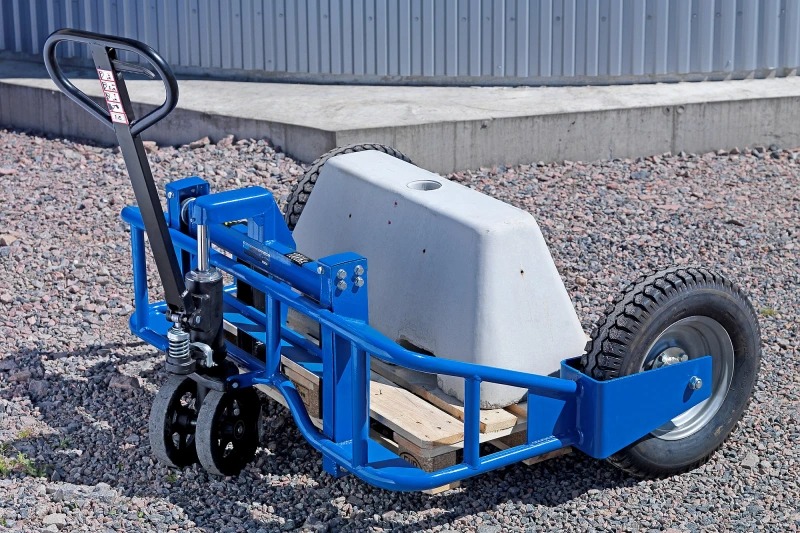
All-terrain pallet jacks solve these problems with larger pneumatic or semi-pneumatic tires, wider frames, higher ground clearance, and reinforced forks. These models are designed for outdoor use on construction sites, lumber yards, farms, and landscaping projects. They can safely handle light grades (up to 15%) and rough surfaces while still moving standard pallets.
Key Considerations for Uneven Surfaces
Specialized Equipment
Choose an all-terrain or rough-terrain pallet jack rated for outdoor use. Look for models with 12–16 inch pneumatic tires, reinforced frames, and at least 6–8 inches of ground clearance.
Safety Hazards
On uneven ground the risk of tipping increases dramatically. Always keep the load low, travel slowly, and never turn sharply. Uneven surfaces also increase the chance of load shifting or forks catching on obstacles.
Operational Limitations
Even all-terrain models have limits. They are not designed for steep hills, deep mud, or loose sand. Maximum safe incline is usually 10–15% depending on load weight and model.
Speed Management
Reduce speed to a slow walk on any uneven surface. Sudden stops or fast turns can cause the jack to tip or the load to slide off the forks.
Steep Incline Warnings
Never attempt to move a loaded pallet jack up or down an incline greater than the manufacturer’s rating. Use a ramp or forklift assistance instead.
Different Types of Pallet Jacks and Their Applications
| Pallet Jack Type | Wheel/Tire Type | Best Surfaces | Typical Applications |
|---|---|---|---|
| Standard Manual Pallet Jack | Small polyurethane or nylon | Smooth concrete, sealed asphalt | Warehouses, retail backrooms, distribution centers |
| Electric Walk-Behind Pallet Jack | Small solid rubber | Flat, level indoor floors | Indoor manufacturing, cold storage, large retail stores |
| All-Terrain / Rough-Terrain Pallet Jack | Large pneumatic or semi-pneumatic | Gravel, dirt, grass, light inclines | Construction sites, lumber yards, landscaping, outdoor storage |
| Stand-Up Electric Pallet Jack | Medium rubber or pneumatic (some models) | Mostly indoor but some outdoor-rated | Loading docks, mixed indoor/outdoor facilities |
What Should You Never Do with a Pallet Jack?
Never use a standard pallet jack on uneven or sloped surfaces. Never carry passengers on the jack. Never exceed the rated load capacity. Never travel with the forks raised more than 4–6 inches off the ground. Never make sharp turns while loaded. Never leave a loaded jack unattended on any incline. Never attempt to force a jack over curbs, thresholds, or large gaps. Following these rules prevents accidents, equipment damage, and costly injuries.
Conclusion
Standard pallet jacks are designed exclusively for smooth, level indoor surfaces and should never be used on uneven ground. Specialized all-terrain models with larger tires and reinforced frames are available for outdoor and rough-surface applications such as construction sites and landscaping. Always match the pallet jack to the terrain, follow manufacturer incline and load limits, and prioritize safety. When choosing equipment, consider models built specifically for the surfaces you work on most often.
 English
  French
  Spanish
  Vietnamese
  Thai
Thai  Italian
  Arabic
  Malay
Malay  Portuguese (Portugal)
  German
  Russian
  Japanese
  Korean
  Lao
Lao  Indonesian
  Myanmar
  Polish
  Danish
  Finnish
  Norwegian
  Swedish
  Bengali
  Tamil
Tamil  Nepali
  Turkish
  Irish
Irish  Kurdish
  Kazakh
  Uzbek
Uzbek  Turkmen
  Kyrgyz
  Tajik
Tajik  Portuguese (Brazil)
  Moroccan Arabic
  Sundanese